


Corn Snake Tank Size: What Size Enclosure Do You Need?

The right corn snake tank size depends on your snake's measured length—not just its age or the number of gallons on a product label. A 48" x 24" x 24" enclosure is a useful larger-habitat reference for many adults, but some corn snakes grow longer than 48 inches and may need a longer enclosure. Smaller, secure habitats can work as temporary grow-out setups for young snakes when their dimensions and furnishing are appropriate.
This guide explains how to compare enclosure length, width, and height; decide when to upgrade; and select a secure tank that leaves room for hides, climbing branches, and a temperature gradient. It also shows how common tank sizes relate to actual REPTIZOO enclosure options.
What Size Tank Does a Corn Snake Need?
Quick Answer: Dimensions Matter More Than Gallons
Choose a corn snake enclosure by comparing its usable dimensions with your snake's actual body length. The space-focused ReptiFiles corn snake guide recommends a habitat at least as long as the snake, about half as wide as the snake is long, and at least 24 inches high, with 48" x 24" x 24" as its baseline adult recommendation. Longer individuals may need longer enclosures. These are ReptiFiles' husbandry recommendations, not a universal legal standard.
A gallon rating describes volume, not the shape of the usable living space. Two tanks with similar volume may offer very different floor lengths and climbing room.
Why Your Snake's Length Matters
Corn snakes vary considerably in adult size. ReptiFiles describes adults as commonly around 3–5 feet long, while PetMD's corn snake care sheet describes adults around 4–6 feet. These are broad ranges rather than a way to predict an individual animal's final length.
A snake measuring 36 inches and one measuring 60 inches should not automatically receive the same enclosure recommendation. The second snake needs a longer habitat under length-based guidance, even if both animals are fully grown. If you are buying ahead for a juvenile, consider its likely future size and whether the enclosure will still provide sufficient room as it develops.
When comparing products, check the usable internal dimensions, not just the advertised external measurements. Frames, door tracks, backgrounds, and internal furnishings can reduce available space slightly.
Minimum vs. Recommended Enclosure Size
Published corn snake care resources do not all use the same minimum. This is worth understanding before treating any gallon figure as a definitive answer.
| Care source | Published adult guidance | How to interpret it |
|---|---|---|
| PetMD | A 40-gallon or larger breeder tank, with encouragement to provide the largest habitat possible | A smaller, traditional volume-based baseline; assess the actual dimensions for the individual snake |
| ReptiFiles | At least 48" x 24" x 24", plus a length-based sizing approach | A more space-focused recommendation that also accounts for climbing and full-body extension |
Rather than asking only whether a tank meets the smallest published recommendation, ask whether your particular snake can stretch out, explore, use climbing opportunities, and move between properly arranged warm and cool zones.
Already comparing dimensions? Browse REPTIZOO front-opening reptile terrariums after identifying the size your snake needs.
Corn Snake Tank Size by Age and Growth Stage
Age is useful background, but measured body length and enclosure conditions are better sizing tools. Growth rates differ, so the table below gives decision criteria rather than rigid age-to-gallon rules.
Baby Corn Snake Tank Size
Very young corn snakes need secure, escape-resistant housing and places to hide. A small, appropriately designed grow-out terrarium can be easier to monitor, particularly when the snake is tiny enough to pass through gaps that would not concern an adult.
A large enclosure is not automatically a problem for a young corn snake. ReptiFiles explains that young snakes may be housed in a well-secured adult-sized enclosure if there are many tight hides and plenty of visual cover. The key is avoiding a large, exposed, difficult-to-secure space—not assuming that a lower gallon number is always better. For more about feeding, monitoring, and early husbandry, see the REPTIZOO baby corn snake care guide.
Juvenile Corn Snake Tank Size
As a corn snake grows, remeasure it periodically and compare its length with the usable length of the current habitat. A 36" x 18" x 18" enclosure can be evaluated as a transitional option for an appropriately sized growing snake. It should not be selected as the default lifelong home for a larger adult.
The enclosure still needs a warm and cool side, at least two suitable hides, stable branches, and secure openings. Plan the next upgrade before the snake's growth leaves too little usable length or space for essential furnishings.
Adult Corn Snake Tank Size
For adults whose measured length fits within the available space, a 48" x 24" x 24" (4x2x2) enclosure is an important starting point for comparison. It offers more floor area and vertical furnishing opportunities than a typical 36-inch-long tank.
However, a 4x2x2 should not be described as sufficient for every adult. If an individual measures roughly 5 feet (60 inches), for example, a 48-inch enclosure does not satisfy the length-equals-snake-length approach. A longer habitat should be considered, with width, height, security, and heating arrangements evaluated as well.
When Should You Upgrade Your Corn Snake's Tank?
Do not wait for a snake to become cramped before investigating the next enclosure. Measure it periodically, inspect how the furnishings affect usable space, and plan ahead of rapid growth.
| Growth stage | What to check | Enclosure approach | Reason to plan an upgrade |
|---|---|---|---|
| Baby / young | Escape gaps, tight hides, accessibility for monitoring | Secure grow-out habitat or densely furnished, secure larger enclosure | Growth, security needs, or inadequate room for safe layout |
| Juvenile / growing | Measured length, usable floor length, warm and cool zones | A 36" x 18" x 18" habitat may be a transitional option | Snake is approaching the enclosure's usable length, or furnishings restrict movement |
| Adult | Full body length, floor area, climbing space, and habitat layout | Compare 48" x 24" x 24" with the individual's measurements | Adult is longer than the enclosure, or usable space is insufficient |
Quick upgrade check: If the snake's body length is approaching the tank's usable length, start choosing the next habitat now. If it already exceeds that length, a longer enclosure is the clearer choice under ReptiFiles' length-based recommendation.
Is a 40-Gallon Tank Big Enough for a Corn Snake?
Why Gallon Labels Can Be Misleading
A gallon figure tells you approximately how much volume a tank encloses. It does not tell you whether that volume is concentrated in height or spread across the floor. For corn snakes, which move across the ground and climb, the distribution of space matters.
A conventional 40-gallon breeder often has a footprint of approximately 36" x 18", though actual dimensions and heights vary by manufacturer. That length is shorter than many adult corn snakes. The label alone cannot establish whether the habitat suits an individual snake.
Comparing 40-Gallon and 4x2x2 Enclosures

| Enclosure format | Approximate dimensions | Sizing consideration |
|---|---|---|
| Typical 40-gallon breeder | Often around 36" long x 18" deep; height varies | Compare actual dimensions with the snake; the 36-inch length can be limiting for many adults |
| REPTIZOO 50-gallon format | 36" x 18" x 18" | Possible transitional option for a smaller or growing snake |
| 4x2x2 / approximately 120 gallons | 48" x 24" x 24" | Useful larger-adult reference when the snake's size fits |
| 6x2x2 format | 72" x 24" x 24" | A longer enclosure format to evaluate for individuals requiring more than 48 inches of length |
The point is not that a gallon label is useless—it can help identify a product category. But real dimensions should determine your final choice. Also allow for the practical difference between exterior product dimensions and interior living space.
When a Longer Enclosure Is the Better Choice
Imagine a corn snake measuring approximately 60 inches. A 48-inch-long enclosure gives it less straight-line length than its body. Following ReptiFiles' size-based method, you would look for a habitat offering at least approximately 60 inches of usable length, along with appropriate width and climbing space.
That does not mean every 60-inch snake must buy a particular branded 6x2x2 product. It means the dimension requirement comes first. Select the material, opening style, and manufacturer only after the space and safety needs are addressed.
How to Choose the Right Corn Snake Tank Dimensions
Floor Space vs. Height
An enclosure's length makes a major difference to full-body extension and the separation of warm and cool ends. Width provides turning, exploring, and furnishing space. Height matters too: corn snakes are capable climbers, and branches and raised areas can make use of vertical space.
A tall tank with insufficient length is not automatically an acceptable substitute for a longer tank. For a predominantly ground-oriented layout, prioritize suitable length and floor area, then add safe vertical enrichment.
Room for Climbing, Hides, and Enrichment
Before choosing dimensions, visualize the furnishings that will actually occupy the enclosure:
- Two snug hides: at least one toward the warm side and one toward the cool side.
- Stable climbing branches: secured so they will not fall, shift, or create unsafe contact with heating equipment.
- Suitable substrate: enough usable depth and floor coverage for the planned habitat, without obstructing doors or ventilation.
- A water dish: accessible and stable, leaving room for movement.
- Visual cover: plants, cork, or other safe furnishings so the snake is not forced into constantly exposed space.
A nominally spacious terrarium can become awkward to use if large decorations block one entire end. Evaluate the finished layout, not just the empty box.
Secure Doors, Ventilation, and Escape Prevention
Corn snakes are adept at finding small openings. A front-opening terrarium can simplify cleaning and equipment placement, but it must have an appropriate latch or locking mechanism. Check lid seating, door gaps, cable ports, and any removable panels after assembly and during routine maintenance.
Good ventilation must work with the actual heating and humidity setup. A mesh top provides a practical equipment-mounting option, but it does not replace careful temperature monitoring. Avoid using adhesive tape inside the enclosure to block gaps; it can contact and injure the snake. ReptiFiles' enclosure guidance discusses security for both front-opening terrariums and aquariums.

Recommended REPTIZOO Enclosure Sizes for Corn Snakes
REPTIZOO offers different configurations in dimensions relevant to corn snake keepers. These are options to compare after measuring your snake, not species-wide guarantees of suitability. Product descriptions below refer to the linked REPTIZOO listings; the husbandry size guidance comes from the care references cited earlier.
48x24x24 — Larger Adult Habitat Option
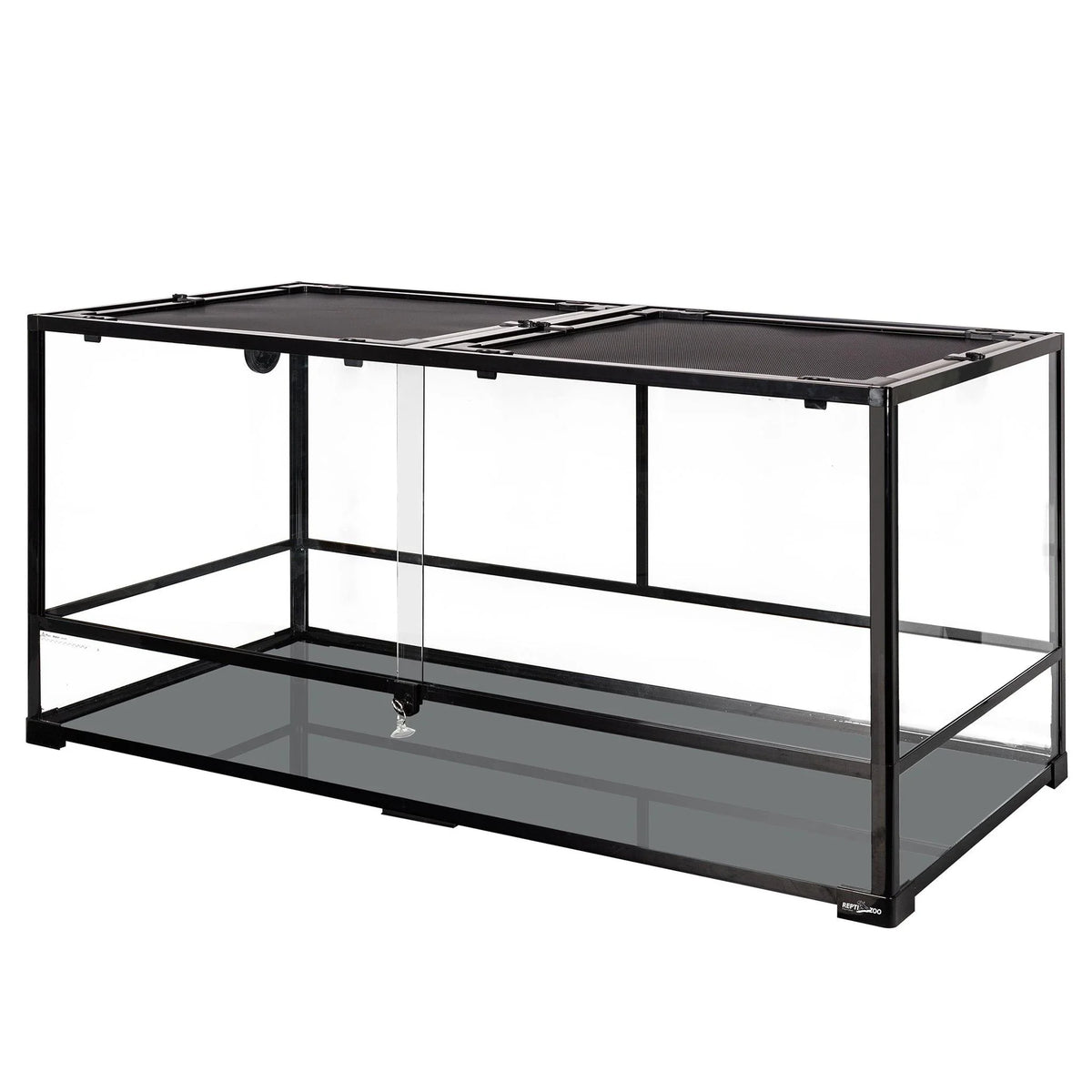
The 48" x 24" x 24" format offers a 48-inch footprint length, 24-inch depth, and room for a naturalistic arrangement of hides and branches. It is a useful choice to evaluate when an adult corn snake's measurements and individual setup requirements are compatible with those dimensions.
Two verified REPTIZOO models offer this size:
REPTI ZOO RK0240 — 120 Gallon Glass Terrarium. This model is listed with glass panels, an ABS frame, front sliding doors with a locking mechanism, a removable mesh top, and a raised waterproof bottom. Those features can make feeding and routine access more convenient while supporting a furnished habitat.
REPTI ZOO NRK0127 — 120 Gallon Folding Terrarium. This model uses tempered glass with a black PVC back panel; it is not an all-PVC enclosure. The listing describes folding assembly, removable mesh top, locking hinged front doors, and a waterproof base. Choose between these models according to access preferences and the precise construction you need.
You can also compare other products in the REPTIZOO 4x2x2 enclosure collection.
36x18x18 — Smaller or Growing Snake Option
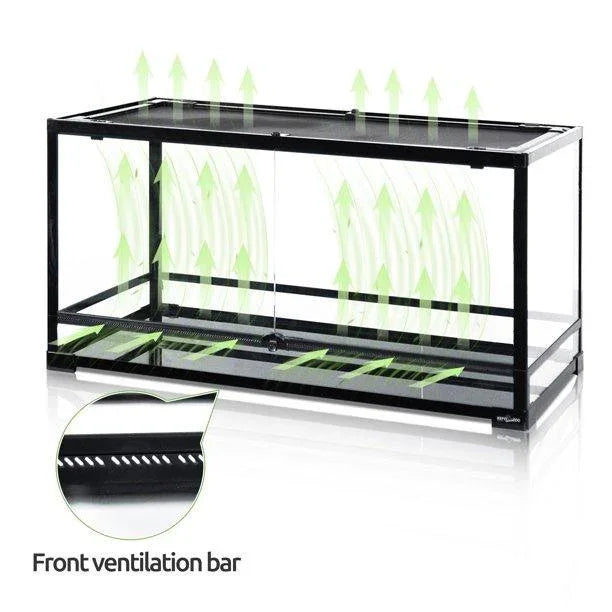
The REPTI ZOO RK361818A 50 Gallon Glass Terrarium measures 36" x 18" x 18" and has double front-opening doors and a locking feature.
For an appropriately sized younger or smaller corn snake, this may serve as a transitional enclosure when it can be safely furnished and the snake has sufficient usable length. It is not the default long-term recommendation for larger adult corn snakes. Consider the eventual upgrade before choosing this format solely to avoid buying a bigger tank initially.
When to Consider a Tank Longer Than 48 Inches
If your snake is longer than the usable length of a 4x2x2, evaluate longer enclosure dimensions. A 6x2x2 (72" x 24" x 24") is one possible size format, though the right width and height should still be assessed for the individual animal and its furnishing plan.
REPTIZOO maintains a 6x2x2 enclosure collection. Product availability and specifications can change, so check the actual listing rather than assuming a particular model is ready to ship.
| REPTIZOO model | Dimensions | When to consider it | Main limitation |
|---|---|---|---|
| RK0240 glass terrarium | 48" x 24" x 24" | Adult habitat with suitable individual length; sliding-door access | 48-inch length may be insufficient for a longer adult |
| NRK0127 glass/PVC-back terrarium | 48" x 24" x 24" | Same size considerations; hinged-door, folding configuration | Same 48-inch length limitation |
| RK361818A glass terrarium | 36" x 18" x 18" | Appropriately sized smaller or growing snakes | Transitional size; not a larger-adult default |
Buying takeaway: Choose the tank that fits the snake you have—or reasonably expect to have—not the one with the most impressive gallon label. After deciding on dimensions, compare REPTIZOO corn snake enclosure options.
Corn Snake Tank Setup Checklist
The enclosure's dimensions only help if you can create a safe, usable habitat inside them. Before moving your corn snake, make sure the selected size supports the following essentials.
Heating and Temperature Gradient
Arrange appropriately controlled heating toward one end of the enclosure so your snake can access both warmer and cooler areas. Use suitable thermostats and digital thermometers, and measure temperatures where the animal actually uses the space. A basking-surface reading is not interchangeable with a warm-side ambient-air reading.
Detailed target temperatures differ across published guides and measurement methods. For species-specific settings, consult the ReptiFiles temperatures and humidity guide and PetMD's corn snake care sheet. Install heating according to the equipment instructions, protecting the snake from direct contact with hot bulbs and fixtures.
Hides, Substrate, Branches, and Water
Plan for at least two appropriate hides, one on each side of the temperature gradient. Add substrate, visual cover, climbing branches, and a stable water dish without crowding the floor or blocking doors. Choose furnishings that are secure, cleanable, and sized for the snake.
Humidity advice differs between published husbandry sources, so this tank-size guide does not prescribe one universal percentage. The enclosure needs enough ventilation, appropriate substrate management, and reliable humidity monitoring for the care approach being followed.
Lighting, Ventilation, and Safety Checks
Provide a consistent day/night cycle. If using UVB, the lamp type, mesh obstruction, fixture position, and distance to the snake must be considered; a UVB bulb's percentage or wattage is not the same as the UV Index at the basking area. Secure lids, door locks, and cable ports before introducing your snake.
Before you buy:
- ☐ Measure your corn snake and consider its likely future size.
- ☐ Compare usable internal length, width, and height—not gallons alone.
- ☐ Confirm room for a warm zone, cool zone, and appropriately placed hides.
- ☐ Check that doors, lid, vents, and cable ports can be secured.
- ☐ Plan substrate depth and safe climbing or enrichment structures.
- ☐ Decide whether this is a grow-out habitat or intended long-term enclosure.
Before your snake moves in:
- ☐ Assemble the tank fully and inspect all gaps.
- ☐ Test heating equipment and its thermostat before occupancy.
- ☐ Verify warm- and cool-zone temperatures with suitable digital instruments.
- ☐ Provide at least two hides plus secure cover and branches.
- ☐ Place a stable water dish and check ventilation and humidity monitoring.
- ☐ Ensure heat and lighting fixtures cannot be contacted by the snake.
- ☐ Close and lock all access points after the final inspection.
Common Corn Snake Enclosure Size Mistakes
Choosing a Tank Based on Gallons Alone
The mistake: Buying a tank labeled “40 gallons” or “120 gallons” without checking its footprint. A tall tank may have a convenient volume rating but insufficient horizontal length for your snake.
What to do instead: Compare length, width, and height against your snake's measured body length and planned furnishings. Use gallons as a secondary description, not a sizing rule.
Keeping a Growing Snake in an Outgrown Tank
The mistake: Assuming the enclosure remains appropriate simply because it worked when the snake was younger. A growing snake may eventually be longer than the available straight-line space.
What to do instead: Measure periodically and research the next enclosure while there is still room to plan. Avoid making an urgent, poorly researched purchase after the tank is already inadequate.
Prioritizing Height Over Sufficient Length
The mistake: Choosing a tall display terrarium because it looks spacious, even though its floor length is short. Climbing enrichment is valuable, but it cannot fully replace opportunities to move and stretch horizontally.
What to do instead: Meet the snake's relevant length and floor-area needs first. Then add enough vertical room for branches and safe exploration.
Overlooking Escape-Proofing
The mistake: Measuring the main glass panels but not checking door tracks, cable openings, ventilation gaps, or the way a removable lid closes. Smaller snakes may exploit openings that look negligible.
What to do instead: Inspect the complete assembled enclosure, including furnishings that could push against a lid or create access to an opening. Use the model's intended lock or latch and recheck it after maintenance.
Corn Snake Tank Size FAQs
What size tank does a full-grown corn snake need?
A 48" x 24" x 24" enclosure or larger is a useful adult baseline according to ReptiFiles, but your snake's measured length remains important. Its preferred sizing method calls for an enclosure at least as long as the snake and approximately half as wide. A longer adult may therefore need a longer enclosure than a standard 4x2x2. Check usable inside dimensions and whether the finished setup leaves adequate space for movement and enrichment.
Is a 40-gallon tank big enough for a corn snake?
Some care sheets, including PetMD, mention 40 gallons or more for adults. Other sources, including ReptiFiles, recommend considerably larger dimensions. A typical 40-gallon breeder has a length around 36 inches, which is shorter than many adult corn snakes. Rather than treating the gallon label as a guarantee, compare its actual dimensions to your animal's length and the habitat features it needs.
Is a 120-gallon tank too big for a corn snake?
Not inherently. A 48" x 24" x 24" enclosure can provide useful space for many corn snakes when the setup is secure and furnished with appropriate hides, cover, branches, and warm and cool areas. A baby snake in a large habitat needs particular attention to escape gaps and monitoring. Conversely, 120 gallons does not automatically mean the tank is long enough for an especially large adult.
Can a baby corn snake live in a large enclosure?
Yes, according to ReptiFiles, a young corn snake can live in a properly secured and densely furnished adult-sized enclosure. Lots of small, snug hiding places and visual cover can make an open space more usable. Some keepers choose a smaller grow-out enclosure for easier security and observation. Either arrangement needs to meet the animal's current needs; size alone does not determine whether it is appropriate.
When should I upgrade my corn snake's tank?
Start planning an upgrade when your snake's measured length approaches the usable length of its existing enclosure, rather than waiting until it has already outgrown the space. Reevaluate whether there is adequate room for warm and cool hides, climbing opportunities, and safe movement. Upgrading earlier can also avoid choosing a poor-fitting enclosure in a rush.
Is a 36x18x18 tank suitable for a corn snake?
A 36" x 18" x 18" enclosure may work as a transitional setup for an appropriately sized growing or smaller corn snake, provided it can be securely furnished and maintained. It is not the default long-term option for larger adults under the more spacious ReptiFiles guidance. Compare the animal's measured length with the tank's usable interior length and have an upgrade plan as it grows.
Do corn snakes need taller or longer tanks?
They benefit from both suitable horizontal space and safe climbing opportunities. Length supports full-body extension and the layout of distinct warm and cool areas; width helps provide useful floor space, while height accommodates branches and other enrichment. For a snake that cannot stretch out in the available floor length, simply choosing a taller tank is not a direct substitute for a longer one.
Can two corn snakes share one enclosure?
Individual housing is the safer default for most keepers. PetMD recommends housing corn snakes separately, while ReptiFiles describes cohabitation as an advanced practice with extra space, resources, and monitoring requirements. Do not choose a larger enclosure solely to place two snakes together. For an ordinary home setup and a straightforward sizing decision, plan one appropriately sized enclosure per snake.
Choose the Right Corn Snake Enclosure
The best corn snake enclosure is not simply the one with the biggest gallon number. Start with your snake's measured length and expected growth, then compare the enclosure's actual usable dimensions, opportunities for climbing and hiding, secure access, and room for proper environmental controls. A 48x24x24 habitat is an important larger-adult option, while longer individuals may need more length and smaller growing snakes may use carefully planned transitional housing.
For complete feeding and husbandry information, see the REPTIZOO corn snake care guide. Once you know the dimensions your snake needs, explore REPTIZOO corn snake enclosures to compare practical habitat options.
References
- ReptiFiles — Corn Snake Terrarium Size Requirements
- ReptiFiles — Corn Snake Temperatures, Lighting & Humidity
- PetMD — Corn Snake Care Sheet
- REPTIZOO official product listings: RK0240, NRK0127, and RK361818A
REPTIZOO Habitat Tip
A great reptile habitat starts with the right environment. Choose an enclosure that provides appropriate space, ventilation, lighting, temperature, and humidity for your reptile’s specific needs.
About REPTIZOO
REPTIZOO helps reptile keepers build complete habitats with thoughtfully designed terrariums, enclosures, lighting, heating, humidity control, and habitat accessories. Whether you're setting up a home for a bearded dragon, gecko, snake, chameleon, turtle, or other reptile, our goal is to make habitat building simpler, safer, and closer to nature.
Explore REPTIZOO habitat solutions and Live in Nature.