


Best Substrate for Ball Pythons: Types, Depth & Setup Guide

The best substrate for ball python enclosures is one that holds moisture without staying wet on the surface and is easy to keep clean. Coarse coconut husk chips, cypress mulch, and suitable natural soil-based mixes are common options in current care guides. None is best for every snake. The right choice depends on how much your enclosure's ventilation dries the air, how well you can manage moisture, the substrate's texture, and how you plan to clean. The comparison below shows where each option fits and how to install it correctly.
What Is the Best Substrate for a Ball Python?
Quick Answer: Best Choices by Setup Type
- Most standard enclosures: coarse coconut husk chips, with cypress mulch as an alternative.
- Naturalistic setups: an additive-free soil-based mix, often topped with leaf litter.
- Bioactive setups: a bioactive-ready soil system with live plants and a cleanup crew.
- Temporary or quarantine setups: paper liners plus a humid hide.
These are use-case suggestions rather than a universal ranking. Monitor actual humidity and surface conditions after any substrate change.
What Makes a Good Ball Python Substrate?
Because ball pythons are commonly kept at moderate to high humidity, look for:
- Moisture retention without a soggy surface.
- Suitable particle size: not so fine it cakes or packs down, not so large it's easy to swallow with food.
- Easy cleaning and low dust when used as directed.
- Compatibility with your enclosure's base, doors, vents, and heat source, plus loose material for burrowing.
- No unsafe additives such as fertilizers, pesticides, fragrances, or dyes.
Ball Python Substrate Options Compared
Table A: Ball Python Substrate Comparison
Moisture retention ratings are qualitative comparisons drawn from husbandry guidance, not laboratory measurements.
| Substrate Type | Moisture Retention | Main Benefits | Limitations | Best-Use Situation | Practical Caution |
|---|---|---|---|---|---|
| Coconut husk chips | Medium–high | Easy to spot-clean; surface can dry between mistings | Thin layers dry quickly | Most standard enclosures | Prepare as the product directs |
| Cypress mulch | Medium–high | Can help retain moisture; natural look | Larger pieces may be swallowed accidentally | Standard or naturalistic enclosures | Choose additive-free material; watch feeding hygiene |
| Fine coconut fiber | High | Useful mix component | Compacts, gets dusty when dry, clings | Soil mixes; carefully managed humid setups | Don't keep it waterlogged |
| Soil-based mix | Medium–high | Burrowable; supports plants | Can turn muddy | Naturalistic setups | Avoid garden soil with additives |
| Bioactive system (soil, plants, cleanup crew) | Varies by mix | Planted living system with decomposer organisms | More setup and ongoing care | Established bioactive enclosures | Still needs waste removal, monitoring, and plant care |
| Paper towels / liners | Low | Easy to inspect and replace | Little moisture buffering | Temporary or veterinarian-directed setups | Monitor humidity; provide a suitable humid hide if needed |
| Aspen shavings | Low | Widely available | Holds moisture poorly; can mold when damp | Disputed for ball pythons | Poor fit for humid setups |

Coconut Husk Chips
Coconut husk chips are coarse pieces of husk, usually sold as compressed blocks that expand with water. Coarse chips can retain moisture while allowing some air spaces, and localized waste may be easier to remove than from fine-textured bedding. ReptiFiles lists a coconut husk chip product among its "good" ball python substrates (ReptiFiles). Limitations include variable chip size, the need to follow product-specific preparation directions, and faster drying in some heavily ventilated enclosures.
Cypress Mulch
Cypress mulch is shredded wood that holds moisture well. PetMD lists it among suitable choices. ReptiFiles places a cypress product in its "okay" tier rather than its preferred group, noting that larger pieces could be a problem if swallowed (ReptiFiles). Choose an additive-free reptile product with consistent particle size. REPTIZOO doesn't sell cypress mulch.
Coconut Fiber / Coco Coir
Coco coir is finely processed husk with a soil-like texture. It holds a lot of moisture but can pack down, get dusty, and stick to a damp snake. ReptiFiles rates a coconut fiber product as "okay" and notes it may get stuck in a ball python's heat pits (ReptiFiles). It may be easier to manage as one part of an appropriate mix rather than as the entire substrate layer.
Natural Topsoil-Based Mixes
Soil-based mixes combine additive-free topsoil with other materials into a burrowable layer that holds moisture and can support plants. Use organic topsoil without fertilizers, weed inhibitors, or pesticides, and avoid overwatering, which turns it muddy. Ratios vary by source. ReptiFiles' DIY tropical mix is 40% organic topsoil, 40% coconut fiber, and 20% play sand, and ReptiFiles notes it isn't bioactive-ready (ReptiFiles). Treat any ratio as a starting point.
Bioactive Substrate Systems
A bioactive setup is a complete system rather than a single material. It combines a bioactive-ready soil substrate, live plants, leaf litter, and a cleanup crew of small invertebrates such as isopods and springtails that break down waste (Zen Habitats). It still needs moisture checks, spot-cleaning, plant care, and periodic refreshes, and a burrowing ball python can disturb plants.
Paper Towels and Aspen: Special-Case Options
Paper towels and liners are easy to inspect and change, which suits temporary setups such as quarantine (see Scenario D). Zen Habitats notes that solid liners make humidity harder to maintain, so you'll usually need a humid hide (Zen Habitats).
Aspen is where sources disagree most:
- PetMD lists it among suitable choices and says to replace it weekly.
- ReptiFiles lists aspen among its "bad" substrates for ball pythons (ReptiFiles).
- Zen Habitats discourages it for tropical setups because it holds humidity poorly and can mold (Zen Habitats).
Part of this disagreement concerns humidity management. Aspen is difficult to keep damp without raising mold concerns, so it is generally a less practical choice for a humidity-dependent enclosure. Do not lower an animal's humidity simply to accommodate a particular bedding.
Once you know which texture suits your setup, explore REPTIZOO's reptile substrate options.
Coconut Husk vs. Coconut Fiber vs. Cypress Mulch

Texture, Moisture Retention, and Cleaning
| Coconut husk chips | Fine coconut fiber | Cypress mulch | |
|---|---|---|---|
| Texture | Coarse chunks | Fine, soil-like | Shredded wood |
| Moisture | In chips, with air gaps | Throughout; can stay wet | Held well |
| Surface | Dries faster | Can stay damp or turn dusty | Moderate |
| Cleaning | Easy to scoop | Waste mixes in | Fairly easy to scoop |
| Watch for | Thin layers drying | Compaction, dust | Large pieces |
Particle size and processing help explain these differences; preparation, layer depth, and airflow also affect how each material behaves. For detailed coir preparation, layering, and drainage, see our coco coir terrarium guide.
Which Is More Suitable for Your Setup?
Coarse husk can be convenient for spot-cleaning; additive-free cypress mulch is another option to evaluate. For a naturalistic mix, fine fiber can be one ingredient rather than the only substrate. The scenarios below show how to decide based on the actual enclosure.
How to Set Up Substrate in a Ball Python Enclosure
Step 1: Check the Enclosure Base and Door Clearance
In the assembled enclosure, mark the lowest point of the door opening; substrate above it can spill out or jam sliding doors. Note any low vents, which must stay uncovered.
Step 2: Choose a Practical Substrate Depth
Specialist guides suggest roughly 2–4 inches or more (see below). Stay below your door line; very deep or bioactive layers may need a taller base or substrate barrier.
Step 3: Prepare the Substrate
Follow the exact product instructions: compressed chips, fine coir, loose mulch, and soil mixes do not all hydrate the same way. Moisten only as needed for the material and target conditions; avoid dripping, standing water, and a persistently saturated surface. Drain excess water before adding the substrate.
Step 4: Create Moisture Zones Without a Persistently Wet Surface
Where appropriate, retain some moisture below the surface while allowing the snake-contact layer to avoid remaining wet. A separate humid hide can provide a localized higher-moisture retreat. Clean, moistened sphagnum moss may be useful there. ReptiFiles lists it among its good substrates because it holds moisture (ReptiFiles), but replace it often to prevent mold (ReptiFiles). A moss-filled hide supplements your main substrate; it isn't a substitute for choosing one that suits the enclosure.
Step 5: Position Hides, Water Bowl, and Décor
Provide snug hides on both the warm and cool sides. Position heavy hides, rocks, and other furnishings on a stable base or secure them so digging or pushing cannot cause them to collapse; avoid balancing heavy décor on loose bedding alone. Set the water bowl where spills are easy to notice. Install heat sources according to their manufacturers' instructions, check enclosure compatibility, and use appropriate thermostatic control.
Step 6: Monitor Humidity and Substrate Condition
Install a reliable digital hygrometer and check readings and substrate condition daily for the first week or two. Ambient humidity also depends on ventilation, room conditions, and misting.
How Deep Should Ball Python Substrate Be?
Depth Recommendations and Their Limitations
Zen Habitats recommends at least 2–4 inches (Zen Habitats), and ReptiFiles recommends at least 4 inches of moisture-retentive substrate to help hold humidity (ReptiFiles). Deeper layers generally hold more moisture, but practical depth also depends on your enclosure's base, door clearance, and setup type.
Substrate Depth in a 48 × 24 × 24-Inch Enclosure
A 48 × 24 × 24-inch horizontal enclosure is a practical example for many adult ball pythons, not a universal minimum or guaranteed fit; your snake's length, floor space, hides, and heat gradient all matter. Listed height isn't usable clearance, so measure inside the assembled enclosure. Deeper substrate also brings the snake closer to any overhead lamp. Our guide to ball python lighting and UVB explains how to recheck that distance.
How Substrate Affects Ball Python Humidity
Moisture Retention vs. Surface Wetness
Three things are often confused:
- Air humidity is what your hygrometer reads.
- Substrate moisture is the water held within the bedding.
- Surface wetness is how damp the layer the snake lies on is.
In many loose-substrate setups, some moisture can be retained beneath a surface that is not continuously wet. A consistently waterlogged top layer or pooled water is not a safe substitute for managing the entire enclosure's humidity and ventilation.
Why Humidity Targets Differ and Where to Measure
Current husbandry sources don't agree on one number:
- ReptiFiles recommends 60–80% during the day and 80–100% at night, based on climate records from the species' range. It notes that brief dips and spikes are unlikely to cause harm, and it advises a probe in the middle of the enclosure plus a second probe inside the humid hide (ReptiFiles).
- PetMD gives 40–60%, rising to about 70% during shedding, checked daily with a hygrometer.
These are different published husbandry recommendations, not interchangeable thresholds. ReptiFiles uses climate data to inform its guidance; neither its high nighttime range nor PetMD's lower range should be treated as a universal target without considering the animal, measured conditions, and current professional advice. Persistent humidity or shedding concerns warrant a reptile veterinarian's input.
Placement matters. Relative humidity changes with temperature, so readings at the warm and cool ends may differ even when the overall water vapor content is similar. Measurements immediately after spraying or next to a water bowl may not represent the wider habitat. Use consistent probe positions, record trends, and adjust the setup gradually.
Which Ball Python Substrate Should You Choose?
Table B: Substrate Options by Enclosure Setup
| Enclosure or Setup Type | Potential Substrate Options | Important Setup Considerations |
|---|---|---|
| Glass enclosure with mesh top | Coconut husk, cypress mulch, husk-and-fiber blend | Mesh releases moisture; check ventilation before adding water |
| PVC or mostly solid-sided enclosure | Coconut husk, cypress mulch, soil mix | Ventilation and humidity vary by design; inspect for wet areas |
| Naturalistic / bioactive | Soil mix or bioactive-ready system | Additive-free ingredients, moisture plan, plants and cleanup crew if bioactive |
| Temporary or quarantine | Paper liners with a humid hide | Easy inspection; follow veterinary guidance |
Scenario A — Your Glass Enclosure Dries Out Quickly
Confirm the reading away from the water bowl. Then check how much open mesh the top has, whether room heating or air conditioning is drying the air, and whether the substrate is thin or dried out. A deeper layer of coconut husk or cypress mulch, moistened lower layers, a humid hide, or partially covering mesh (without blocking lighting or heat) can help. If ventilation is the main cause, changing bedding alone may not be enough.
Scenario B — Your Substrate Stays Wet Too Long
Check misting frequency, bowl spills, airflow, and whether fine fiber is compacting into a dense, wet layer. More water won't help, and more substrate may only spread the problem. Reduce misting, improve airflow, remove soggy areas, and consider a coarser material. Persistently wet bedding can turn unhygienic and moldy. For skin changes, blisters, breathing changes, or other health concerns, see a reptile veterinarian; changing substrate isn't a medical treatment.
Scenario C — You Want a Naturalistic or Bioactive Habitat
An ordinary soil mix provides a naturalistic loose surface but still needs cleaning and eventual replacement; ReptiFiles specifically notes that its DIY tropical mix is not bioactive-ready. A bioactive setup also needs plant-compatible substrate, leaf litter, a functioning cleanup crew, and a drainage or moisture-management design appropriate to the enclosure. Choose it only if you can monitor the entire living system.
Scenario D — You Need a Temporary Easy-to-Inspect Setup
Paper liners make waste and shed easy to see and are quick to change. Monitor humidity and provide an appropriate humid hide if needed. If your snake is in quarantine or under treatment, follow your reptile veterinarian's protocol over general advice.
Recommended REPTIZOO Substrate and Enclosure Options
REPTIZOO Coconut Husk Chip Bedding
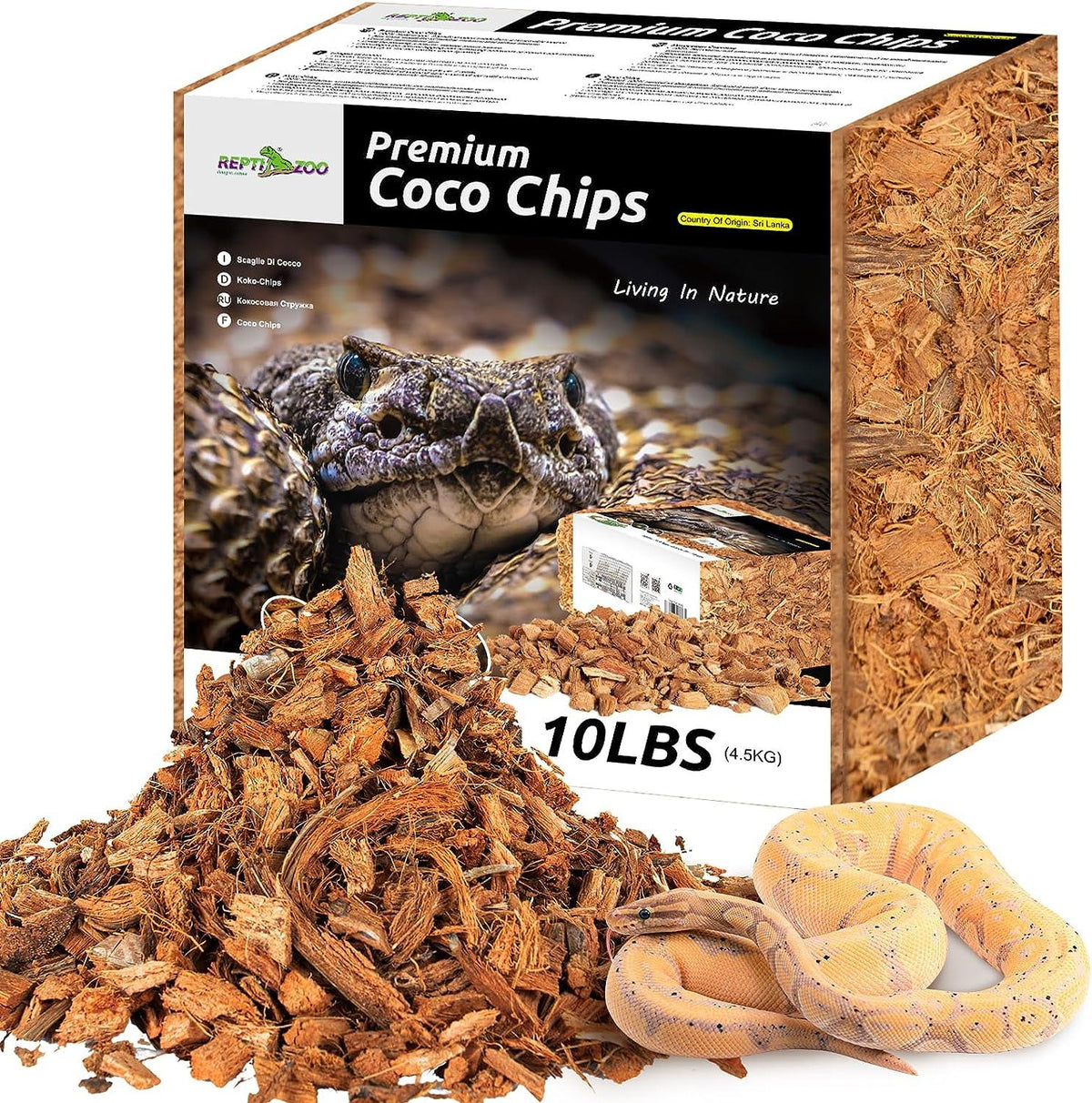
The REPTIZOO 72 Quart Coconut Chip Substrate is compressed coconut husk chip bedding that expands with water, and its listing names ball pythons among intended users. Its coarse texture makes it a candidate for standard enclosures where moisture retention and practical spot-cleaning are priorities, provided the actual humidity and surface conditions are checked. Follow the product's preparation directions.
REPTIZOO Coconut Fiber for Appropriate Mixes
The REPTIZOO 72 Quart Coconut Fiber Substrate is a separate, finer product sold as a compressed block. Its finer texture affects how moisture distributes through the layer and may lead to compaction or material clinging to the snake. Consider it as one component of a suitable naturalistic mix rather than assuming it is the best standalone option for every ball python.
A 48 × 24 × 24-Inch Enclosure Layout Example
If your current enclosure already gives your snake enough space, changing the bedding may be all you need. If not, here's one 48 × 24 × 24-inch example.

The REPTIZOO RK0240 48 × 24 × 24-inch terrarium has front sliding access, a removable screen top, and a raised waterproof base. Its listing shows a 5.5-inch waterproof-height option. That describes the lower section, not a usable substrate depth. Its horizontal footprint can support warm- and cool-side hides, a water bowl, and humidity monitoring when arranged appropriately. Check the individual snake's length and the assembled tank's usable dimensions before deciding whether this model offers sufficient space.
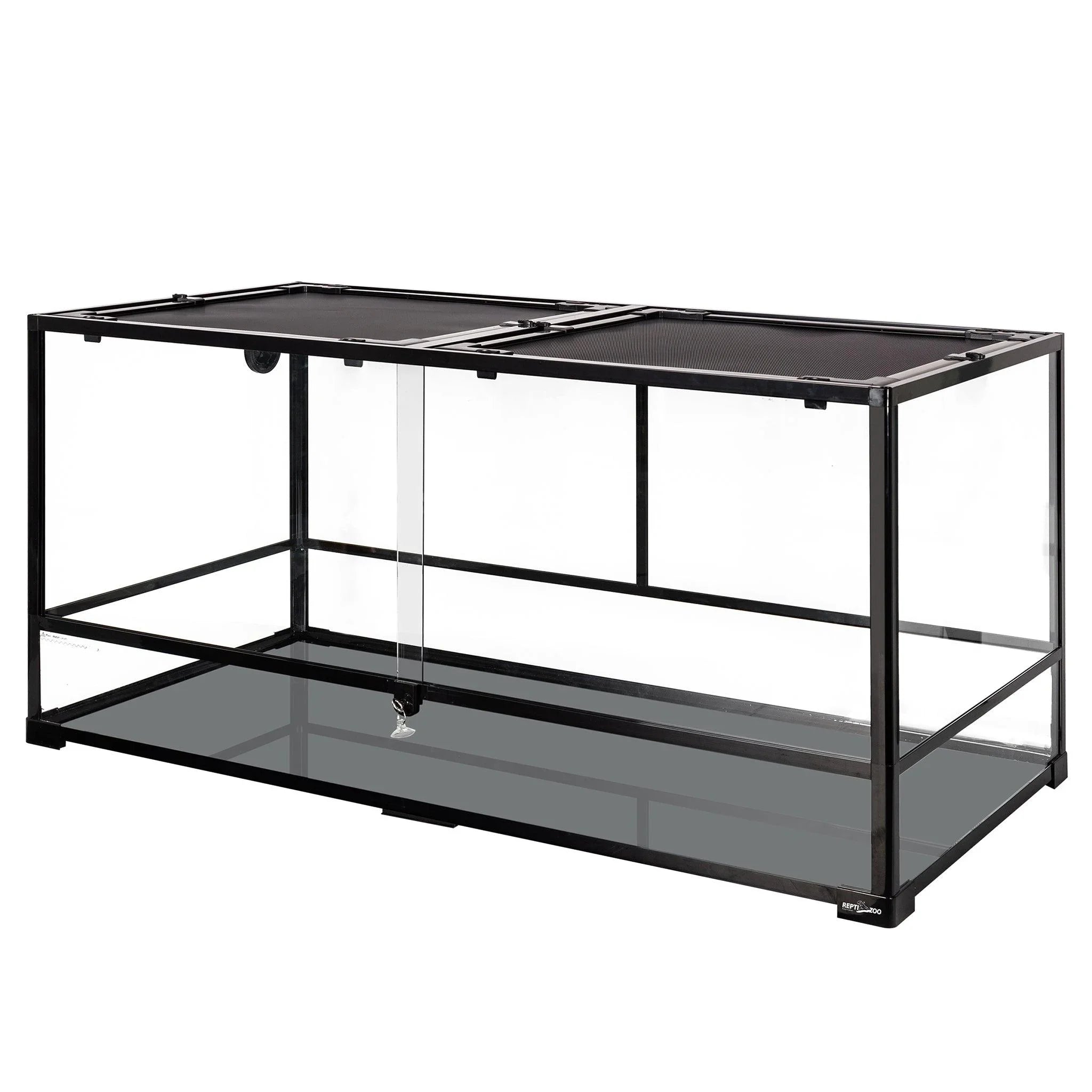
For a solid back panel, the NRK0127 is also 48 × 24 × 24 inches, with glass sides and a black PVC back panel. Its listing describes a 4.8-inch waterproof base and front ventilation strips; keep substrate clear of those vents. Compare other layouts among REPTIZOO's ball python enclosures.
How to Clean and Replace Ball Python Substrate
Daily Checks and Spot Cleaning
Check daily for feces, urates, shed, spills, and food remains, and spot-clean as Zen Habitats recommends (Zen Habitats). Remove soiled material with a margin of surrounding substrate and top up.
When to Replace Contaminated or Saturated Bedding
Replace substrate when it's heavily soiled, moldy, foul-smelling, or stays soggy despite adjustments. Persistent wetness shows as a dark, matted surface, water pooling at the bottom, or bedding that never dries between mistings.
Published schedules are source-specific guidelines, not one mandatory calendar:
- ReptiFiles: about monthly, or at least quarterly, for non-bioactive substrate (ReptiFiles).
- Zen Habitats: every 3–4 months for non-bioactive substrate.
- PetMD: weekly changes for aspen.
Table C: Substrate Maintenance
| Maintenance Task | What to Check | When to Take Action |
|---|---|---|
| Spot cleaning | Feces, urates, shed, food remains | Remove right away, with surrounding substrate |
| Moisture check | Surface vs. lower-layer dampness | If lower layers are too dry, adjust carefully; remove or replace persistently soggy material |
| Humidity reading | Hygrometer in a consistent location | Adjust gradually when readings stay outside your chosen range |
| Mold and odor check | Fuzzy growth, musty or foul smell | Remove affected areas; replace widely affected substrate |
| Full replacement | Overall soiling, compaction, breakdown | When the layer can't be cleaned effectively (non-bioactive) |
| Bioactive upkeep | Plants, cleanup crew, leaf litter | Refresh leaf litter and substrate as needed |
Non-Bioactive vs. Bioactive Maintenance
Non-bioactive substrate is spot-cleaned and eventually replaced. A bioactive layer is replaced less often, but you still remove larger waste, monitor moisture, and care for plants and the crew. Neither can be neglected.
Common Ball Python Substrate Mistakes
- Ignoring enclosure humidity, or treating fine coir and coarse husk as interchangeable.
- Leaving the contact surface persistently wet.
- Using pine or cedar shavings, which sources consistently discourage because of their aromatic oils (PetMD; Zen Habitats).
- Using products with unverified fertilizers, pesticides, fragrances, or other additives.
- Leaving soiled areas or mold in place.
- Blocking front doors or vents with too much substrate.
- Expecting substrate alone to control heating, humidity, or health.
Ball Python Substrate Setup Checklist
Checklist A: Choosing Substrate
- ☐ I have a credible humidity-management plan and know where I will measure it.
- ☐ The material fits my enclosure and can be maintained without a persistently wet surface.
- ☐ Particle size isn't dusty-fine or easy to swallow.
- ☐ I have checked the label for fertilizers, pesticides, fragrances, dyes, and other additives.
- ☐ It suits my cleaning routine (standard or bioactive).
Checklist B: Installing and Monitoring Substrate
- ☐ Door openings and vents stay clear in the assembled enclosure.
- ☐ I followed the product-specific preparation instructions and avoided pooling water.
- ☐ Depth suits my enclosure, humidity needs, and lamp clearance.
- ☐ Warm and cool hides, heavy décor, and the water bowl are secure and stable.
- ☐ Heat sources follow their installation requirements and use appropriate thermostatic control.
- ☐ A digital hygrometer is in a consistent location and checked regularly.
- ☐ I spot-clean daily and replace soggy, moldy, or heavily soiled areas.
Frequently Asked Questions About Ball Python Substrate
What is the best substrate for a ball python?
There's no single best option. Coarse coconut husk, cypress mulch, and additive-free soil mixes are common choices; the right one depends on ventilation, moisture management, and cleaning routine.
Is coconut husk good for ball pythons?
Yes, for many setups. Coarse coconut husk can retain moisture and be convenient to spot-clean when prepared and maintained appropriately. ReptiFiles includes a coconut husk chip product among its recommended options.
Is coconut fiber better than coconut husk?
Not necessarily. Fine fiber has a smaller particle size and may compact, become dusty if excessively dry, or cling to the snake. Coarse chips behave differently. Neither material is universally better; the enclosure and maintenance routine matter.
Can ball pythons live on aspen bedding?
Sources disagree: PetMD lists aspen as an option, whereas ReptiFiles and Zen Habitats discourage it for humidity-dependent ball python setups. Aspen can mold if damp, so it is usually not a first choice when moisture-retentive substrate is needed.
Is cypress mulch suitable for ball pythons?
It can be. PetMD lists it as suitable, and ReptiFiles rates it "okay," noting larger pieces could be swallowed. Choose an additive-free product with consistent particle size.
How deep should ball python substrate be?
Zen Habitats recommends at least 2–4 inches, and ReptiFiles recommends at least 4 inches. Practical depth depends on your enclosure's base, door clearance, and setup type.
How often should I change ball python bedding?
Spot-clean daily. Full-replacement guidance varies by source, from about monthly to every few months for non-bioactive substrate. Replace sooner if bedding stays soggy, grows mold, or smells bad.
Can I use bioactive substrate for a ball python?
Yes, with a bioactive-ready soil system, live plants, leaf litter, and a cleanup crew. It still needs moisture checks, plant care, spot-cleaning, and periodic refreshes.
Final Thoughts: Choose Substrate for the Habitat You Actually Have
The best ball python substrate suits your enclosure's ventilation, how you manage moisture, and how you clean. Coarse coconut husk, selected cypress mulches, and properly prepared soil-based mixes are options to compare; fine coir, paper liners, and aspen require additional context. Install at a practical depth, keep the surface from staying wet, and monitor consistently.
Browse REPTIZOO's reptile substrate collection to compare materials. If your habitat lacks space for hides, a heat gradient, and easy maintenance, compare ball python enclosures. For broader husbandry, see our ball python care sheet.
References
- ReptiFiles. Best Ball Python Substrate Options & Setup Guide (specialist husbandry guidance)
- ReptiFiles. Ball Python Lighting, Temperature & Humidity Guide (specialist husbandry guidance)
- Zen Habitats (Madeline Smith). Ball Python Complete Substrate Guide (specialist husbandry guidance from an enclosure retailer)
- PetMD (Maria Zayas, DVM; reviewed by Melissa Witherell, DVM). Ball Python Care Sheet (veterinarian-written care sheet)
REPTIZOO Habitat Tip
A great reptile habitat starts with the right environment. Choose an enclosure that provides appropriate space, ventilation, lighting, temperature, and humidity for your reptile’s specific needs.
About REPTIZOO
REPTIZOO helps reptile keepers build complete habitats with thoughtfully designed terrariums, enclosures, lighting, heating, humidity control, and habitat accessories. Whether you're setting up a home for a bearded dragon, gecko, snake, chameleon, turtle, or other reptile, our goal is to make habitat building simpler, safer, and closer to nature.
Explore REPTIZOO habitat solutions and Live in Nature.