


Blue Tongue Skink Enclosure: Size, Setup & Best Tank Options

Choosing the right blue tongue skink enclosure is one of the most important husbandry decisions you will make for this species. Blue tongue skinks are heavy-bodied, primarily terrestrial lizards that roam, dig, and forage across the floor of their habitat — so the enclosure has to be built around usable horizontal floor space first, and everything else (substrate depth, heat, UVB, humidity, hides, and decor) is layered on top of that footprint.
This guide is written the way an experienced keeper actually shops: from the floor up. We'll walk through blue tongue skink tank size, how a 4x2x2 (48" x 24" x 24") footprint compares with the larger 6x2x2 recommendation now used by welfare-focused husbandry references, how to think about glass vs. PVC, how deep substrate should be, and how heat and UVB geometry change once you fill the floor with several inches of bedding. At the end, we match that decision to specific REPTIZOO 4x2x2 enclosures so you can move from planning to purchase.
Quick Answer: What Size Enclosure Does a Blue Tongue Skink Need?
- Published adult guidance varies by source. RSPCA Australia suggests an appropriate adult blue-tongue enclosure of roughly 1.2–1.8 m long × 0.6 m wide × 0.6–0.9 m high. Current ReptiFiles guidance recommends at least about 12 sq ft of permanent floor space, commonly a 6x2x2 (72" x 24" x 24") enclosure.
- A 4x2x2 (48" x 24" x 24") enclosure sits near the lower end of the RSPCA published adult range, but it is below ReptiFiles' current 12 sq ft minimum recommendation. It remains a widely used practical baseline; where space and budget allow, additional horizontal floor space is preferable.
- 36" x 18" x 18" is a juvenile or transitional setup, not a preferred long-term adult enclosure.
- A 40-gallon "breeder"-style tank is not adequate long term for an adult blue tongue skink.
- Extra height is not a substitute for floor space. A 48" x 24" x 36" enclosure has the same 8 sq ft footprint as a 4x2x2 — the extra 12 inches helps with substrate depth, lighting geometry, and decor, not roaming room.
- Locality matters. Australian and Indonesian blue tongue skinks share the same size logic but need different humidity, substrate, and temperature strategies (covered below).
Blue Tongue Skink Enclosure Size at a Glance
| Enclosure Size | Floor Space | Best Use | Adult Long-Term Context |
|---|---|---|---|
| 36" x 18" x 18" | ~4.5 sq ft | Juvenile, temporary, quarantine or hospital use | Not preferred as permanent adult housing |
| 48" x 24" x 24" (4x2x2) | ~8 sq ft | Common 4x2x2 baseline for adults | Near the lower end of the RSPCA adult range; below the current ReptiFiles 12 sq ft minimum |
| 48" x 24" x 36" | ~8 sq ft | Deeper substrate, better lamp geometry, planted/semi-bioactive setups | Same footprint as 4x2x2 — not a horizontal-space upgrade |
| 72" x 24" x 24" (6x2x2) | ~12 sq ft | Meets the current ReptiFiles-style welfare-oriented adult target | Recommended where practical, especially for very active or larger adults |
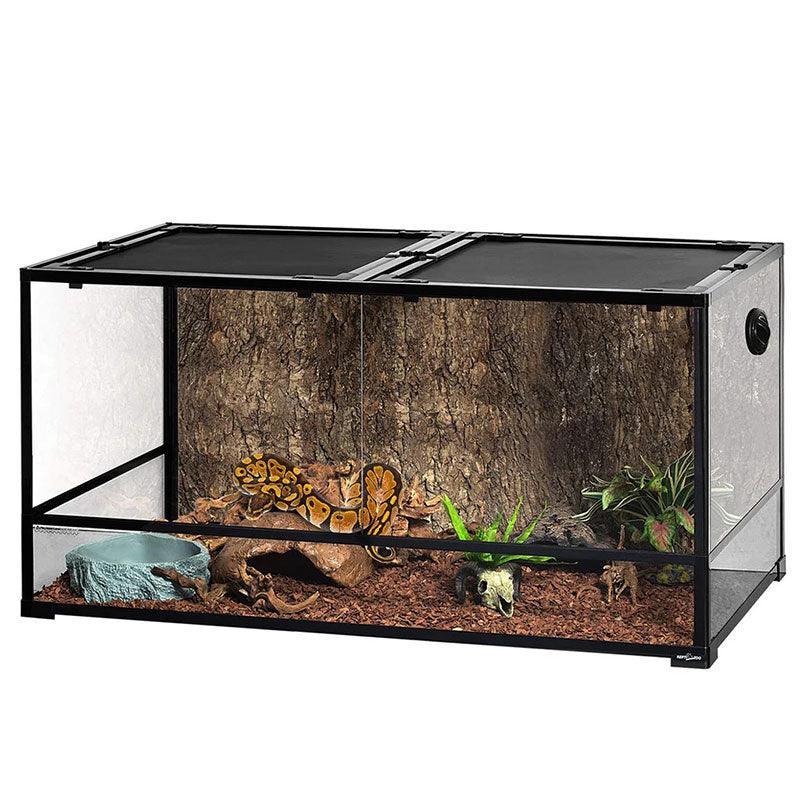
Build the Enclosure From the Floor Up
Instead of shopping by gallon label, shop by dimensions and usable interior volume. Gallon ratings were designed for holding water, not for housing a terrestrial lizard, and two "120-gallon" enclosures can have very different floor space depending on how tall they are. For a blue tongue skink, the floor is where the animal lives, so the floor is what you're really buying.
The order of decisions in this guide:
- Adult footprint — how much floor the animal actually needs.
- Enclosure material — glass vs. PVC and how that affects heat and humidity.
- REPTIZOO 4x2x2 enclosure options — matching the plan to a specific product.
- Setup checklist — the components that go into the enclosure.
- Substrate depth — deep, diggable bedding as a core principle.
- Usable internal height — what's left above the substrate for lamps and basking geometry.
- Heating and UVB layout — building a thermal gradient, not a single temperature.
- Locality-specific humidity — Australian vs. Indonesian ranges.
- Hides, water, and decor — cover, security, and enrichment.
- Common enclosure mistakes.
1. Adult Footprint: Why Horizontal Space Wins
Blue tongue skink size and why it drives enclosure size
Adult blue tongue skinks are stocky, ground-dwelling lizards that commonly reach roughly 17–24 inches in total length, depending on species and locality. Because they carry that length low to the ground and travel primarily by walking, their enclosure should be judged on length × width, not height.
A useful mental model: imagine your skink walking a straight line from one end of the enclosure to the other, then turning around. If it can only take one or two steps before hitting a wall, the enclosure is too small — no matter what the gallon label says.
Is a 4x2x2 enclosure big enough for a blue tongue skink?
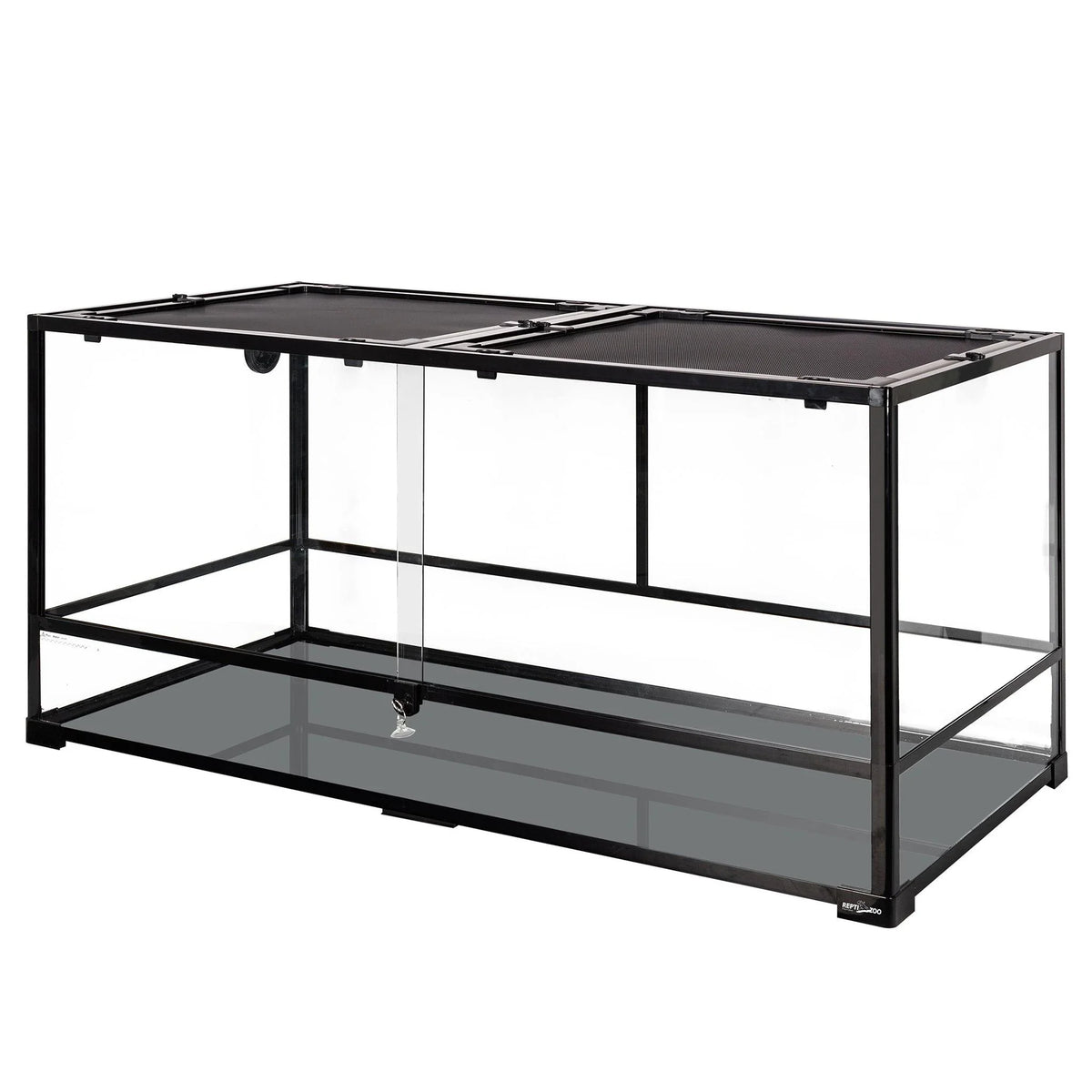
A 4x2x2 enclosure sits near the lower end of the RSPCA's published adult size range, but it is smaller than ReptiFiles' current 12 sq ft minimum recommendation. Where space and budget allow, additional horizontal floor space is preferable.
For keepers who cannot practically go to 6x2x2, a 4x2x2 is a reasonable, commonly used baseline that:
- Provides 48 inches of length for a workable thermal gradient (hot end, cool end, and a genuine middle).
- Provides 24 inches of depth so the animal can turn, burrow, and choose cover away from the front glass.
- Provides 24 inches of height — enough clearance for lamps after you add deep substrate.
Is a 6x2x2 better for a blue tongue skink?
Where practical, yes. A 6x2x2 gives roughly 50% more horizontal floor area than a 4x2x2 while keeping the same 24-inch depth, which is well-suited to the way blue tongue skinks actually move. A 6x2x2 also meets ReptiFiles' current 12 sq ft floor-space recommendation for adult housing.
Is a 36" x 18" x 18" enough?
A 36" x 18" x 18" enclosure can work as a juvenile or transitional setup while a young skink grows out, or as a short-term quarantine/hospital enclosure. It is not a preferred long-term adult home. The footprint is too tight to build a proper thermal gradient plus multiple hides plus a water bowl plus open floor for foraging.
Can a blue tongue skink live in a 40-gallon tank?
A standard 40-gallon breeder (roughly 36" x 18" x 18" in footprint) has the same limitations. It is a starter or grow-out size, not a destination enclosure for an adult.
Do not split a 4x2x2 enclosure in half to house an adult blue tongue skink in one section. Blue tongue skinks are also generally kept solitary — housing two adults in a divided or shared enclosure risks stress and injury.
2. Glass vs. PVC Enclosure for a Blue Tongue Skink
Both glass and PVC can house a blue tongue skink well. The right choice depends on your room, your climate, and your priorities — not a universal "PVC is always better" rule.
[IMAGE: glass vs PVC enclosure comparison] Alt: glass vs PVC blue tongue skink enclosure
Glass front-opening terrariums
- Excellent visibility on multiple sides.
- Front-opening doors make spot-cleaning and handling much easier than top-opening aquariums.
- Screen tops allow lighting to sit above the mesh (important because UVB does not effectively pass through glass).
- Large expanses of glass generally lose heat and humidity faster than solid PVC panels, which can be an advantage in warm rooms and a challenge in cool or dry rooms.
PVC enclosures
- PVC construction generally reduces heat loss compared with large expanses of glass. REPTIZOO describes its Advanced PVC enclosure as offering better heat preservation than glass.
- Solid panels can make it easier to hold higher ambient humidity, though room climate, ventilation, substrate moisture, and misting strategy still matter.
- Lighter weight than a comparably sized all-glass tank, which can simplify enclosure placement.
- Solid side and back panels reduce visual exposure and cross-viewing.
Practical rule of thumb: if your home runs cool or dry, or you keep an Indonesian-type skink that needs higher humidity, PVC often makes life easier. If you keep an Australian-type skink in a moderate room and value multi-sided visibility and easy access, a front-opening glass terrarium is a strong option. Neither material guarantees stable temperatures, correct humidity, lower electricity bills, or better health on its own — the setup around it does most of the work.
3. REPTIZOO 4x2x2 Enclosure Options
The following REPTIZOO enclosures are all built around the 48" x 24" footprint that this guide uses as its baseline. All three provide roughly 8 sq ft of horizontal floor area — a 4x2x2 baseline that sits near the lower end of the RSPCA adult range and below ReptiFiles' current 12 sq ft minimum. Keepers who can accommodate a larger footprint should consider sizing up.
REPTIZOO 4x2x2 Glass Option — RK0240
- 48" x 24" x 24" (120-gallon) glass terrarium with a 48" x 24" horizontal footprint.
- Front sliding-door access for daily spot-cleaning, feeding, and handling.
- Top screen ventilation so UVB and basking fixtures can sit above the mesh.
- 5.5" waterproof lower section designed to hold moisture-retentive substrate up to the sealed height.
- Practical room for substrate, warm-side and cool-side hides, a basking platform, and a warm-to-cool gradient across the 48-inch length.
- Sits near the lower end of the RSPCA published adult range and below the current ReptiFiles 12 sq ft floor-space minimum; keepers who can accommodate a 6x2x2 should consider sizing up.
Best for keepers who want a front-opening 120-gallon reptile terrarium at the 4x2x2 baseline and are comfortable managing humidity and heat retention in glass.
REPTIZOO 4x2x2 PVC Option
- Same 48" x 24" x 24" footprint as the glass options, so the husbandry plan doesn't change.
- PVC construction that REPTIZOO describes as offering better heat preservation than glass.
- Solid side and back panels that reduce visual exposure and can help hold ambient humidity, though ventilation, substrate moisture, and misting strategy still matter.
- Lighter weight than a comparably sized all-glass build.
Best for keepers in cooler or drier homes, Indonesian-type skinks kept at higher humidity, or anyone prioritizing climate stability over multi-sided visibility. See the REPTIZOO 120-gallon PVC reptile enclosure product page for current specifications.
REPTIZOO Black-Tinted 4x2x2 Glass — RKF0318B
- 48" x 24" x 24" footprint, same 4x2x2 baseline as above.
- Black-tinted side and rear glass panels that reduce visual exposure compared with a fully clear enclosure. REPTIZOO positions this as helpful for animals that prefer a more visually private space; keepers should still assess their own animal's behavior.
- Clear front visibility for observation and handling.
- Waterproof floor designed for deep substrate.
- Glass construction with front-opening access.
Best for keepers who want the black-tinted 4x2x2 reptile terrarium look and glass build quality, but prefer a more visually enclosed feel on the sides and back — often a good middle ground between full-clear glass and full PVC.
Best for Extra Substrate / Lighting / Vertical Setup Flexibility — REPTIZOO 180 Gallon 48" x 24" x 36"
- 48" x 24" footprint — the same 8 sq ft of floor space as the 4x2x2 models. Not a horizontal-space upgrade.
- 36 inches of height for deeper substrate, raised basking surfaces, more forgiving lamp-to-basking geometry, and taller decor.
- Tempered glass with double sliding doors.
- Top mesh ventilation.
- Waterproof base up to approximately 7 inches for deeper substrate layers.
- Integrated wire management.
The additional 12 inches of height can make deeper substrate, raised basking spots, internal lighting geometry, decor, and planted or semi-bioactive setups easier to manage. Extra height does not replace additional horizontal floor space — if your priority is more roaming room, look at 6x2x2, not taller enclosures. Product details: REPTIZOO 180-gallon 48x24x36 glass terrarium.
Browse the current lineup of REPTIZOO reptile terrariums to compare glass and PVC options side by side.
Note on 6x2x2: REPTIZOO also maintains a 6x2x2 enclosure collection and custom 72-inch options. Availability can vary, so check the current [REPTIZOO 6x2x2 collection]([REPTIZOO 6x2x2 COLLECTION LINK]) if you want to follow a 12 sq ft floor-space target. RK0240, the 4x2x2 PVC, and RKF0318B remain the principal readily shoppable 4x2x2 recommendations here.
4. Blue Tongue Skink Enclosure Setup Checklist

| Component | Purpose | Placement | Key Consideration |
|---|---|---|---|
| Enclosure | Defines usable floor space, thermal gradient length, and lamp geometry | Away from drafts, direct sun, and heavy foot traffic | 4x2x2 baseline; size up toward 6x2x2 when practical |
| Substrate | Digging, burrowing, humidity buffering | Across the floor, kept below the front door track/sill | Roughly 4–6 in / 10–15 cm; slope deeper toward the rear where the enclosure allows |
| Basking heat lamp | Creates a warm basking surface for thermoregulation | Above the warm end, over a solid basking surface | Adjust wattage to hit target surface temperature; use a dimmer or thermostat |
| UVB fixture | Supports vitamin D3 synthesis and natural behavior | Above the screen top, overlapping the primary basking zone | UVB does not effectively pass through glass; mesh reduces output |
| Digital probe thermometer | Measures ambient air temperature | One probe warm end, one probe cool end at animal height | Analog stick-on dials are not accurate enough |
| Infrared thermometer (IR gun) | Measures the actual basking surface temperature | Aimed at the basking spot | Surface temperature ≠ ambient temperature |
| Digital hygrometer | Measures humidity at animal level | On the cool side at approximately animal level; a second sensor near the warm side can reveal the gradient | Verify against your locality's target range |
| Warm-side hide | Security while thermoregulating warm | Under or near the basking zone | Snug fit; opaque preferred |
| Cool-side hide | Security while cooling off | Opposite end from the basking zone | Snug fit; opaque preferred |
| Humid hide (optional but commonly recommended) | Supports shedding, especially for drier-kept locales | Mid-to-cool side, filled with damp sphagnum or similar | Refresh moisture as needed |
| Water bowl | Drinking and soaking | Cool side, away from the basking lamp | Heavy and tip-resistant; large enough to soak |
| Basking surface | Solid platform to warm the animal's body | Directly beneath the basking lamp | Flat stone, thick branch, or cork slab |
| Cork bark / wood / rocks | Cover, sightline breaks, enrichment | Distributed across warm, middle, and cool zones | Stable and non-collapsing on soft substrate |
| Leaf litter / plants (live or artificial) | Additional cover; bioactive humidity buffering | Across open floor sections | Live plants require a supporting substrate and light plan |
5. Substrate Depth: Deep and Diggable
Blue tongue skinks dig. They burrow to thermoregulate, to feel secure, and — in gravid females — to nest. A shallow layer of bedding on a terrarium floor doesn't meet that behavioral need.
- Aim for a deep, diggable substrate layer across most of the floor. Current ReptiFiles guidance calls for approximately 4–6 inches (10–15 cm) of deep, soft, loose substrate for digging.
- In front-opening enclosures, keep substrate below the door track or sill at the front. Deeper substrate can be sloped or concentrated toward the rear and dedicated digging areas where the enclosure design allows.
- Match substrate moisture to locality:
- Australian / drier types — a drier or lightly moistened naturalistic mix, depending on species and locality.
- Indonesian types — more moisture-retentive substrate appropriate for higher humidity, without going swampy.
- Do not present one substrate recipe as correct for every blue tongue skink.
- A bioactive blue tongue skink enclosure — live plants, leaf litter, and a clean-up crew over a drainage/false-bottom layer — is a popular option because it maintains substrate depth and gradient moisture. It is not required, but it pairs well with a 4x2x2 or 6x2x2 footprint.
Why this matters for enclosure choice: deep or moisture-retentive substrate is easier to manage in an enclosure with an appropriately sealed, moisture-resistant lower section and enough substrate-barrier height. That single requirement rules out a lot of generic tanks and is one of the main reasons purpose-built reptile terrariums are worth the money.
See also: Blue Tongue Skink Substrate Guide
6. Usable Internal Height (After Substrate)
Nominal exterior dimensions do not always equal exact usable interior space. Door sills, waterproof bases, mesh frames, and substrate contour all change the picture.
In a nominal 24-inch-tall enclosure, a deep substrate layer can remove several inches of effective vertical clearance before the basking platform and lamp geometry are even considered. That remaining clearance has to accommodate:
- The height of the basking surface (log, flat stone, cork slab).
- The distance from the basking surface up to the basking lamp.
- The distance from the top of the mesh to the UVB fixture.
- Enough headroom that the animal cannot climb up and directly contact the bulb.
This is why extra height is useful once your footprint is already correct, and why simply stacking a taller enclosure on top of a small footprint doesn't solve the problem. If you plan to run deep bioactive substrate plus a chunky basking platform, a taller 48" x 24" x 36" variant can give you more comfortable lamp geometry without changing the footprint.
7. Heating: Build a Gradient, Not a Number
A single "enclosure temperature" is the wrong mental model. You are building a gradient across the length of the enclosure:
- A basking zone at one end, warm enough for effective thermoregulation on the basking surface.
- A cool end at the opposite end, meaningfully cooler than the basking zone.
- A night-time drop appropriate for the species/locality.
Starting Reference Temperatures
Values below are current ReptiFiles starting references, not universal veterinary prescriptions — surface and ambient temperatures are different, species/locality matters, and actual bulb wattage must be adjusted based on measured enclosure conditions.
| Measurement | Starting Reference |
|---|---|
| General basking surface | 100–105°F / 37–40°C |
| Tiliqua scincoides basking surface | 105–115°F / 40–46°C |
| Australian cool side (day) | 70–85°F / 21–29°C |
| Indonesian cool side (day) | 75–85°F / 24–29°C |
| Australian night | 65–75°F / 18–24°C |
| Indonesian night | 70–75°F / 21–24°C |
Measurement matters more than nominal bulb wattage:
- Use an infrared thermometer to check the actual basking surface temperature.
- Use a digital probe thermometer to check ambient temperatures at animal height on the warm and cool sides.
- Adjust wattage, bulb distance, or thermostat setpoints based on what you measure — not on what the box says.
8. UVB: Geometry Beats a Single Number
Best-practice husbandry is to provide appropriate UVB for a blue tongue skink. A few rules hold regardless of the exact bulb:
- UVB does not effectively pass through standard glass or most plastics. Mount UVB fixtures above a screen top or use a manufacturer-approved in-enclosure fixture.
- Screen mesh reduces UVB output reaching the animal, sometimes substantially. Factor this in when choosing bulb strength and mounting distance.
- The correct mounting distance depends on the specific fixture and reflector, whether mesh is in the path, and how tall the basking surface sits above the substrate. There is no single bulb-independent number.
- The UVB fixture should overlap the primary basking zone, so heat and UVB coincide over the same spot. The animal must still be able to move away from both by traveling toward the cool end.
- Substrate depth changes geometry. Because you've added several inches of bedding, the basking surface sits higher than it would in an empty tank. Recalculate the lamp-to-basking distance after the enclosure is fully set up.
The real goal is to create an appropriate basking-zone UV environment for your species, not to memorize one distance figure. Where possible, verify UVB output at basking height with an appropriate UV meter, and replace bulbs on the manufacturer's schedule. Any specific UVI targets or mounting distances should be interpreted alongside the exact bulb, fixture, and mesh combination they refer to.
See also: Reptile UVB Lighting Guide
9. Locality-Specific Humidity
"Blue tongue skink" is not one animal. Australian and Indonesian species come from meaningfully different environments, and their humidity targets are not interchangeable.

Representative Humidity Ranges by Species / Locality
Values below reflect current ReptiFiles guidance. Verify against your exact species/locality.
| Species / Locality | Representative Humidity Range |
|---|---|
| Northern | 40–60% |
| Eastern | 40–60% |
| Blotched | 40–50% |
| Centralian | 20–40% |
| Western | 20–40% |
| Shingleback | 20–40% |
| Merauke | 60–80% |
| Classic Indonesian | 60–80% |
| Halmahera | 60–80% (per current ReptiFiles guidance) |
| Kei Island | 60–80% |
| Irian Jaya | 60–80% |
| Tanimbar | 60–80% |
Do not compress every Australian species into a single number, and do not compress every Indonesian locality into a generic "high humidity." Substrate choice, ventilation, enclosure material (glass vs. PVC), misting strategy, and room climate all interact. In a dry home, a moisture-retentive substrate in a PVC enclosure will hold higher humidity between mistings; in a humid home, a screen-top glass enclosure and drier substrate mix will help prevent stagnant, overly wet conditions.
Measure with a digital hygrometer at animal level — a primary sensor on the cool side, and optionally a second sensor near the warm side to reveal the gradient.
See also: Reptile Humidity Guide
10. Hides, Water, and Decor
For a 4x2x2 or 6x2x2 blue tongue skink enclosure, plan the floor with the animal's sightlines in mind:
- At least two hides, positioned so the skink can choose between the warm end and the cool end without crossing open ground. A dedicated humid hide is useful for shedding, especially for locales kept at lower ambient humidity.
- A sturdy, tip-resistant water bowl large enough for the animal to soak in if it chooses. Blue tongue skinks are strong for their size and will flip lightweight bowls.
- Cover across the floor — cork bark, flat stones, driftwood, leaf litter, and (in bioactive setups) live or artificial plants. An overly exposed enclosure may provide too little cover and security.
- A dedicated basking surface — a flat rock or thick branch under the basking lamp — so the animal can raise its core temperature efficiently.
- Enrichment rotation. Rearranging cork bark, adding new leaf litter, or offering forage-scatter feeding uses the enclosure the way it was intended.
Decor in a reptile enclosure functions as cover, sightline breaks, and structure that supports natural behavior. Choose pieces for what they do inside the habitat, not just how they look from the outside.
11. Common Blue Tongue Skink Enclosure Mistakes
- Buying by gallon label instead of dimensions. Two "120-gallon" enclosures can have very different footprints.
- Treating extra height as a substitute for floor space. A 48" x 24" x 36" tank is a taller 4x2x2, not a bigger footprint.
- Skipping deep substrate because the enclosure lacks an appropriately sealed, moisture-resistant lower section.
- Applying one humidity number to every blue tongue skink regardless of locality.
- Placing a UVB bulb above solid glass and assuming meaningful UV reaches the animal.
- Using stick-on analog thermometers instead of digital probes and an IR thermometer.
- Housing two adults together or splitting a 4x2x2 into two halves.
- Bare, open floor plans with no cover, sightline breaks, or hides on both thermal ends.
12. Which REPTIZOO Blue Tongue Skink Enclosure Should You Choose?
Every 48" x 24" model below still provides approximately 8 sq ft of horizontal floor area. The 48" x 24" x 36" model is a height upgrade, not a floor-space upgrade.
| REPTIZOO Option | Dimensions | Material | Best For | Setup Advantage | Important Limitation |
|---|---|---|---|---|---|
| RK0240 | 48" x 24" x 24" | Glass | Keepers who want a clear-view 4x2x2 baseline with easy front access | Front sliding doors, top screen, 5.5" waterproof lower section | 4x2x2 footprint sits near the lower end of the RSPCA adult range and below ReptiFiles' 12 sq ft minimum |
| REPTIZOO 4x2x2 PVC | 48" x 24" x 24" | PVC | Cooler / drier homes, or Indonesian-type skinks kept at higher humidity | REPTIZOO describes it as offering better heat preservation than glass; solid panels help hold humidity | Less multi-sided visibility; still requires proper ventilation and misting strategy |
| RKF0318B | 48" x 24" x 24" | Black-tinted glass | Keepers who want glass build quality with reduced visual exposure on sides and rear | Clear front, darker sides/back, waterproof floor | Same 4x2x2 baseline — not a floor-space upgrade |
| 180 Gallon 48x24x36 | 48" x 24" x 36" | Glass | Deep substrate, raised basking, planted / semi-bioactive builds | Double sliding doors, waterproof base up to ~7", wire management, more forgiving lamp geometry | Same 8 sq ft footprint as 4x2x2 — extra height only |
If your goal is more roaming room, plan around a 6x2x2 footprint (roughly 12 sq ft) — see the [REPTIZOO 6x2x2 collection]([REPTIZOO 6x2x2 COLLECTION LINK]) for current availability. If your goal is more headroom for substrate, lighting, and decor within the same footprint, the 48" x 24" x 36" is the option to look at.
FAQ: Blue Tongue Skink Enclosure
What size enclosure does an adult blue tongue skink need?
Published guidance varies by source. RSPCA Australia suggests roughly 1.2–1.8 m long × 0.6 m wide × 0.6–0.9 m high for an adult. Current ReptiFiles guidance recommends at least about 12 sq ft of permanent floor space — commonly a 6x2x2 (72" x 24" x 24"). A 4x2x2 (48" x 24" x 24") sits near the lower end of the RSPCA range and below ReptiFiles' 12 sq ft minimum, but remains a widely used practical baseline where a larger enclosure isn't feasible.
Is a 4x2x2 enclosure big enough for a blue tongue skink?
A 4x2x2 is a common practical baseline. It sits near the lower end of the RSPCA published adult range and below ReptiFiles' current 12 sq ft floor-space minimum. If you have the space and budget, sizing up toward 6x2x2 is generally preferable.
Is a 6x2x2 better for a blue tongue skink?
For most adults, yes — where practical. A 6x2x2 provides roughly 12 sq ft of floor space (about 50% more than 4x2x2) while keeping the same 24-inch depth, which aligns with ReptiFiles' current welfare-oriented recommendation.
Is a 120-gallon enclosure enough for a blue tongue skink?
A 120-gallon terrarium built as 48" x 24" x 24" gives you the 4x2x2 baseline. Judge by dimensions rather than gallon label — two "120-gallon" tanks can have different footprints and heights.
Can a blue tongue skink live in a 40-gallon tank?
A 40-gallon breeder is realistic only as a juvenile or grow-out enclosure. It is not adequate as long-term adult housing.
Can an adult blue tongue skink live in a 36" x 18" x 18" enclosure?
Not as preferred long-term housing. A 36x18x18 is best used for juveniles, grow-outs, quarantine, or temporary hospital setups. Adults should move up to at least a 4x2x2, and ideally toward a 6x2x2 where practical.
Is glass or PVC better for a blue tongue skink?
Both work. Glass front-opening terrariums offer visibility and easy access; PVC generally reduces heat loss compared with large expanses of glass and can make higher humidity easier to hold. Choose based on your room climate, your animal's locality, and your priorities.
How deep should blue tongue skink substrate be?
Current ReptiFiles guidance recommends approximately 4–6 inches (10–15 cm) of deep, soft, loose substrate for digging. In front-opening enclosures, keep substrate below the door track at the front and slope it deeper toward the rear where the enclosure allows. Match substrate moisture to locality.
Do blue tongue skinks need UVB?
Best-practice husbandry is to provide appropriate UVB. ReptiFiles notes that blue tongue skinks can survive without UVB when dietary vitamin D3 is supplied, but recommends UVB as part of modern husbandry.
What humidity does a blue tongue skink need?
It depends on species/locality. Representative ranges from current ReptiFiles guidance: many Australian species around 20–60%, and many Indonesian species around 60–80%. Verify the range for your exact species/locality and measure with a digital hygrometer at animal level.
Can a baby blue tongue skink go straight into an adult-sized enclosure?
Generally, yes — a juvenile can use a larger enclosure when it has enough hides and cover to feel secure, easily accessible food and water, and an appropriate temperature gradient. A small enclosure is not automatically required simply because the skink is young. What matters is that the young animal is not being asked to navigate a bare, exposed space to find its basic resources.
Sources & Further Reading
- RSPCA Australia — Blue Tongue Skink Care
- ReptiFiles — Blue Tongue Skink Enclosure Size Requirements
- ReptiFiles — Blue Tongue Skink Temperatures, UVB & Humidity
- ReptiFiles — Blue Tongue Skink Substrate
- Official REPTIZOO product pages — for exact REPTIZOO dimensions and product features cited in this article (RK0240, 4x2x2 PVC, RKF0318B, 180-gallon 48x24x36).
Sources are paraphrased, not quoted. Verify all specific temperature, humidity, substrate depth, and UVB numbers against the current version of the referenced source and against your exact species/locality and equipment.
Ready to Build Your Blue Tongue Skink Enclosure?
Start with the footprint, not the lamp. Decide whether you can accommodate a 6x2x2 for stronger long-term floor space or a 4x2x2 as a practical baseline, then choose glass or PVC based on your room and your animal's locality. From there, plan 4–6 inches of diggable substrate (kept below the front door track), a proper thermal gradient measured at the basking surface, UVB geometry that overlaps the basking zone and accounts for mesh and substrate depth, and humidity that matches your specific species — not a one-size-fits-all number.
When you're ready to shop the 4x2x2 baseline, compare the REPTIZOO 4x2x2 glass RK0240, the 4x2x2 PVC enclosure, and the black-tinted RKF0318B side by side, or step up in height with the 180-gallon 48" x 24" x 36" terrarium when your build calls for deeper substrate and more forgiving lamp geometry. If you can go bigger on floor space, check the [REPTIZOO 6x2x2 collection]([REPTIZOO 6x2x2 COLLECTION LINK]) for current 72" x 24" x 24" options. Full catalog: REPTIZOO reptile terrariums.
REPTIZOO Habitat Tip
A great reptile habitat starts with the right environment. Choose an enclosure that provides appropriate space, ventilation, lighting, temperature, and humidity for your reptile’s specific needs.
About REPTIZOO
REPTIZOO helps reptile keepers build complete habitats with thoughtfully designed terrariums, enclosures, lighting, heating, humidity control, and habitat accessories. Whether you're setting up a home for a bearded dragon, gecko, snake, chameleon, turtle, or other reptile, our goal is to make habitat building simpler, safer, and closer to nature.
Explore REPTIZOO habitat solutions and Live in Nature.