


Boa Constrictor Enclosure: Size, Setup & Large Habitat Options

A boa constrictor enclosure should be planned around one thing first: the individual snake's measured and expected adult size. Not around a gallon label, not around whatever tank happens to be on sale. Boas sold under the broad "boa constrictor" label can vary considerably in adult size depending on species or locality, sex, genetics, and the individual animal, so the enclosure that suits one keeper's boa may not suit the next.
This guide walks that decision in order: size the animal first, translate that into usable length, depth, and climbing height, layer in heat / humidity / hides / substrate / security, then match the plan to a specific enclosure — including where REPTIZOO's standard sizes fit, and when the honest answer is a custom build.
Quick Answer: What Size Enclosure Does a Boa Constrictor Need?
Boa enclosure size should follow the snake's measured length rather than gallon capacity. Published standards differ, but current guidance generally favors enough length for the snake to stretch, meaningful depth for turning and furnishing, and usable climbing height. ReptiFiles, for example, recommends about a 4x2x2 enclosure for 2–5 ft juveniles and about a 6x3x3 for 6–8 ft adults. Verify a specific range against a reliable source for your snake.
Boa Constrictor Enclosure Size by Life Stage
Published enclosure recommendations vary. ReptiFiles currently uses a size-based framework that scales enclosure dimensions with the snake's length, while other veterinary and husbandry sources (for example, PetMD) emphasize the broader principle that an adult boa habitat should allow the snake to fully stretch out and that enclosure length should accommodate the snake's body length. Both approaches share the same underlying idea: use the snake's measured length as the primary planning input.
The table below separates one published husbandry framework from the REPTIZOO product path. The REPTIZOO column is a shopping reference only; it does not replace the enclosure guidance.
| Snake Length / Stage | Example Published Guidance (ReptiFiles) | Primary Planning Concern | Possible REPTIZOO Path | Important Limitation |
|---|---|---|---|---|
| Baby, shorter than 2 ft | ~2 ft L × 1.5 ft W × 1 ft H | Security, easy monitoring, multiple hides, stable warm side | Not the primary focus of this product line — a smaller starter enclosure or a well-furnished larger enclosure both work when planned correctly | A large enclosure is not automatically wrong for a baby; a bare enclosure is |
| Juvenile / growing boa, ~2–5 ft | ~4 ft L × 2 ft W × 2 ft H | Room to grow without repeatedly re-buying enclosures | Possible grow-out / appropriately sized boa pathway via REPTIZOO snake enclosure options at the 4x2x2 footprint | Plan the next enclosure before the snake outgrows this one |
| Adult, ~6–8 ft | ~6 ft L × 3 ft W × 3 ft H | Real horizontal length, meaningful depth for turning and furnishing, usable climbing height | Larger standard option via the REPTIZOO 6x2x2 collection (currently 72 × 24 × 24 in) | Shallower and shorter than the 6x3x3 guidance for 6–8 ft boas — a 24" depth and 24" height may be limiting for some individuals |
| Large adult, longer than 8 ft | ~8 ft L × 4 ft W × 4 ft H | Physical fit, structural support, safe climbing | Custom pathway via REPTIZOO custom snake enclosures with custom dimensions, including deeper-than-24-inch configurations where required | Do not force a large snake into the largest standard SKU available — size the enclosure to the snake |
ReptiFiles also describes an approximate planning formula of snake length × half snake length × half snake length (enclosure L × W × H). This is one source's rule of thumb rather than a universal veterinary requirement, and it should be cross-checked against your specific snake's behavior and needs.

Baby Boa Enclosures
Newly acquired baby boas benefit from an enclosure they can easily orient in, with multiple secure hides on both the warm and cool ends and enough cover across the floor that no area feels fully exposed. The enclosure does not have to be small — it has to be furnished. A larger enclosure with proper cover is preferable to a small enclosure with none.
Juvenile and Growing Boa Enclosures
Growing boas can outpace planning. Choose an enclosure that fits the current snake and its expected growth over the next several months, and identify the next upgrade in advance. ReptiFiles currently uses a 4x2x2 (~4 ft L × 2 ft W × 2 ft H) as its juvenile 2–5 ft guideline, which is a useful reference point for this stage.
Adult Boa Enclosures
Adults commonly need meaningfully more length than a 4x2x2 provides. For 6–8 ft boas, ReptiFiles' current framework describes roughly a 6x3x3, which is deeper and taller than a standard 6x2x2. Whether a 24" depth and 24" height are enough for a given adult depends on the individual snake's dimensions and behavior.
Large Adults and When Custom Sizing Makes Sense
Once an adult boa exceeds what standard commercial enclosures can comfortably fit — physically, in coil, and stretched — the practical answer is usually a custom enclosure rather than the biggest off-the-shelf SKU available. ReptiFiles' current framework for boas longer than 8 ft is around 8 ft L × 4 ft W × 4 ft H, dimensions no standard commercial SKU covers cleanly.
Is a 4x2x2 Big Enough for a Boa Constrictor?
A 4x2x2 can work for a boa whose measured length and setup requirements fit that enclosure. ReptiFiles currently uses a 4x2x2 as its juvenile 2–5 ft guideline, so it is a defensible size for that life stage rather than a permanent adult solution. It should not automatically be treated as an adult enclosure — many boas will outgrow a 4x2x2 in usable floor space, in usable climbing height, or both.
If you buy a 4x2x2, buy it for the snake you have now and know what your next enclosure will be.
CTA: Comparing enclosure sizes? Browse the REPTIZOO snake enclosure options once you know the footprint your boa actually needs.
Is a 6x2x2 Big Enough for an Adult Boa?
It can be for some individuals, but not as a universal adult standard. A 6x2x2 (72" x 24" x 24") provides substantially more horizontal length than a 4x2x2 and may suit boas whose measured size and setup requirements fit that enclosure. Two important caveats:
-
Current published guidance from ReptiFiles recommends approximately 6x3x3 for boas in the 6–8 ft range, so a 24-inch depth and 24-inch height may be limiting for larger individuals.
-
Height that is not furnished with sturdy branches or shelves adds air, not habitat.
A 6x2x2 may work for an individual boa whose measured size and setup requirements fit that footprint, but it should not be treated as the default long-term enclosure for adult boas. For boas approaching the 6–8 ft range, some current husbandry guidance recommends additional depth and usable height, such as approximately 6x3x3. Larger or more actively climbing individuals may therefore require a deeper and/or taller enclosure, often custom.
Floor Space vs Height: Why Boa Enclosures Need Both
Boa constrictors are commonly described in current husbandry sources as semi-arboreal — primarily terrestrial, but willing to use height when it is offered. That has two practical implications for enclosure planning: they need real horizontal room, and any height you provide has to actually be usable.
Horizontal Movement
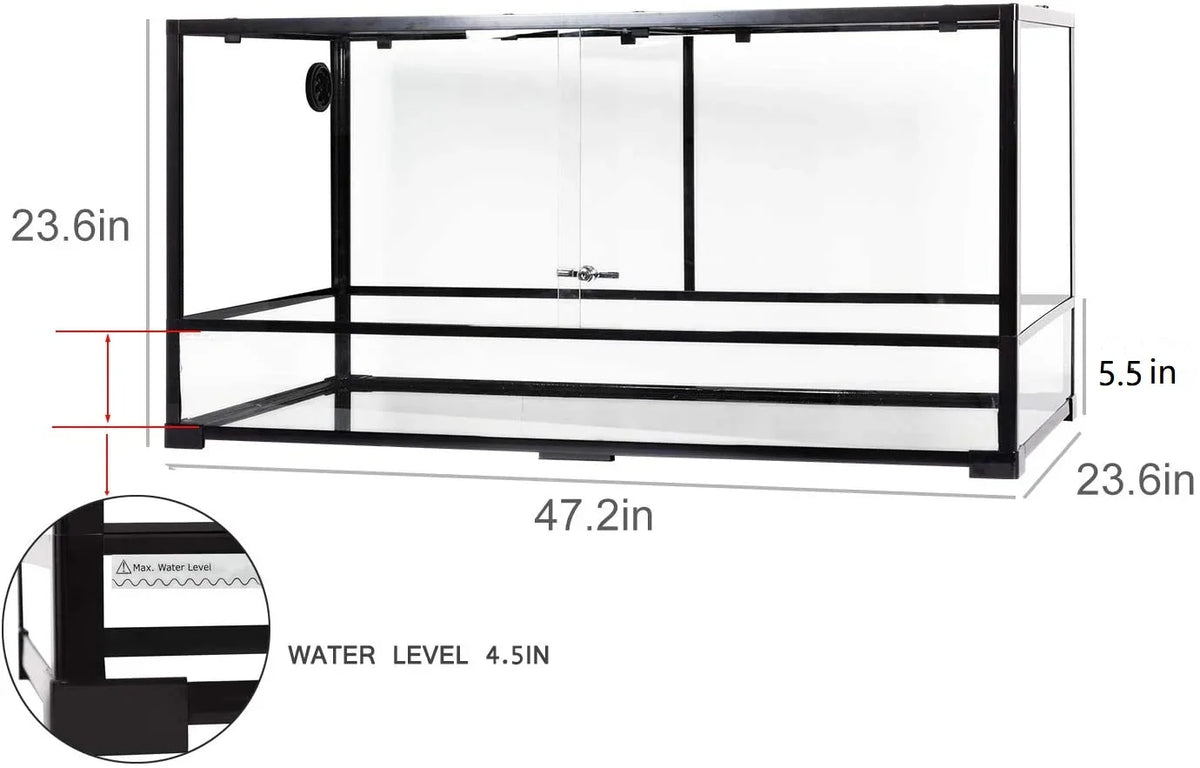
Enclosure length is the single most useful dimension for a boa. Length lets the snake stretch, sets the distance between the warm and cool ends, and determines how far the snake can travel between hides. Compare footprint (length × depth) before you compare gallon labels — two "120-gallon" enclosures can have very different floor space.
Usable Climbing Space
Height only helps if there is structure to climb on. An empty tall enclosure is a tall enclosure the snake ignores. Sturdy branches, cork slabs, and platforms turn vertical inches into functional habitat. For a heavy-bodied adult, the structure must actually support the snake's weight; hollow driftwood that shifts under the animal is worse than no climbing structure at all.
Why Height Must Be Furnished, Not Empty
A tall enclosure that is bare above the substrate does not give you a bigger habitat — it gives you a bigger gap between the snake and the lights. Plan branches, shelves, and cover before buying the enclosure so you know the height you're paying for is height the snake will use.
Glass vs PVC vs Custom Boa Enclosures
None of the three is universally best. Ventilation design, room climate, heat source, substrate, and enclosure dimensions can matter as much as the panel material itself.
| Glass | PVC | Custom | |
|---|---|---|---|
| Heat / humidity management | Larger glass panels generally dissipate heat and humidity more readily than solid panels | Solid panels generally retain heat and humidity more efficiently | Depends on materials specified in the build |
| Visibility | Excellent multi-sided visibility | Front visibility; solid sides / back reduce visual exposure | Configurable to preference |
| Weight | Heavier for a comparable size | Lighter than a comparably sized all-glass enclosure | Depends on the build |
| Large-size availability | Widely available up to common standard sizes; very large glass enclosures become rare and heavy | Widely available in large sizes | Sized to specification, including footprints beyond common standard SKUs |
| Customization | Limited to catalog sizes | Some manufacturers offer configurable dimensions | Fully customizable to the snake's requirements |
| Cleaning / maintenance | Glass is easy to wipe; heavy to move | Solid interior surfaces are easy to wipe; lighter to reposition | Depends on materials |
| Best use case | May be practical when visibility is a priority and environmental parameters can be maintained | Can make heat / humidity retention easier in cooler or drier environments | Snakes whose size exceeds what standard SKUs cover, or setups needing very specific dimensions |
Glass
Glass front-opening terrariums offer strong visibility on multiple sides and easy daily access. They tend to dissipate heat and humidity more readily than solid PVC panels, which the setup around them can compensate for.
PVC
PVC enclosures generally retain heat and humidity better than large expanses of glass, though ventilation, substrate, and misting strategy still matter. They are lighter than a comparably sized all-glass build, which simplifies placement.
Custom Large Enclosures
Custom sizing becomes relevant when an adult boa's dimensions exceed what standard commercial enclosures can comfortably fit. REPTIZOO's custom snake enclosure pathway supports customizable dimensions, including deeper-than-24-inch configurations where required.
Which Makes Sense for Your Setup?
A decision framework, not a winner:
-
Prioritize visibility and can manage temperature / humidity in the room → glass is often practical.
-
Cooler or drier room, or a locality that benefits from stronger heat / humidity retention → PVC can make the environment easier to maintain.
-
Adult snake that exceeds standard SKUs, or a specific footprint no off-the-shelf enclosure matches → custom.
Boa Constrictor Enclosure Setup Checklist
Heating and Thermal Gradient
Set up a warm-to-cool gradient across the length of the enclosure so the snake can thermoregulate by moving. A gradient means a distinct warm end (with the heat source over a stable surface), a distinct cool end, and a middle zone.
PetMD's boa care guidance lists a warm end around 90–95°F and a cooler area around 75–80°F. Measure temperatures at the snake's level with appropriate monitoring equipment, and adjust the setup for the individual animal and enclosure.
Thermostat and Temperature Monitoring
Any heat source that can raise temperatures beyond safe levels should be controlled by a thermostat. Measure actual enclosure temperatures with digital probes at the warm and cool ends, and — where relevant — an infrared thermometer for surface temperatures. Adjust wattage, bulb distance, or thermostat setpoints based on what you measure.
Humidity and Ventilation
ReptiFiles suggests roughly 55–75% ambient humidity for boa constrictors while emphasizing normal fluctuations and allowing the enclosure to dry appropriately, with higher humidity commonly used around shed. Do not target one fixed number continuously; ventilation, substrate, water surface area, and room climate all interact. Measure with a digital hygrometer at animal level.
Substrate
Substrate has several functional jobs: managing moisture, staying clean between spot-cleans, allowing the snake to burrow or explore where relevant, and matching the husbandry approach you have chosen (naturalistic, bioactive, or simple hygienic). Choose a substrate that holds humidity in your target range, does not compact into hard cakes, and is easy to spot-clean.
Hides and Cover
Provide at least two secure hides — one on the warm end and one on the cool end — so the snake never has to choose between security and temperature. Additional cover across the floor (cork bark, flat wood, plants) reduces exposure and encourages normal movement. Snug, opaque hides are used more than large, open decorative caves.
Water Bowl
Use a heavy, stable bowl that the snake can access easily. Water-bowl placement can influence enclosure humidity — a bowl positioned near the warm end evaporates faster and raises ambient humidity, while a bowl on the cool end evaporates more slowly. Choose placement based on the humidity pattern and heating layout you are maintaining, rather than treating warm-side or cool-side as universally correct.
Strong Branches and Climbing Shelves
Any climbing structure has to hold the snake's weight without shifting. For adult boas that is not a trivial requirement — thin decorative branches from other reptile sections may collapse under a heavy-bodied snake. Anchor branches to the enclosure or to substrate-supported bases, position them so a fall does not land on a water bowl or heat source, and re-check stability after every deep clean.
Lighting and UVB Considerations
Many traditional care guides describe UVB as nonessential for boas, while current welfare-focused husbandry sources such as ReptiFiles recommend providing appropriately managed UVB (treating Boa constrictor as a Ferguson Zone 2 reptile). If UVB is used, output at the snake's level depends on the specific fixture, mesh obstruction, and mounting distance, so follow the current lamp/manufacturer guidance rather than a generic figure. Remember that standard glass and most plastics block UVB.
How to Make a Boa Enclosure Secure
Adult boas are strong, and door and opening security should be planned in from the start:
-
Secure front doors with functional locks or latches appropriate to the enclosure's size and weight.
-
Cable and tubing openings should be sized precisely — the smallest gap that still fits the cable, sealed with an appropriate grommet.
-
Screen tops on top-opening enclosures need locking clips or a heavy top.
-
Heavy branches and decor must be anchored so the snake cannot dislodge them into doors or against the glass.
-
Avoid exposed adhesive or hardware — sharp screw ends, protruding brackets, and unsanded cuts inside the enclosure are injury risks.
Recommended REPTIZOO Enclosure Path by Boa Size
Match the enclosure to the snake, not the other way around. The pathway below is organized by snake size, not by "best overall."
48" x 24" x 24": Grow-Out and Appropriately Sized Boa Applications
A REPTIZOO 48" x 24" x 24" horizontal enclosure aligns with the size ReptiFiles currently uses as its juvenile 2–5 ft guideline. It can be a workable grow-out or appropriately sized boa pathway when the individual snake fits that footprint. It is not the default permanent adult boa enclosure. Buy it for the snake you have now, and plan the next enclosure before the snake outgrows it. See the REPTIZOO snake enclosure options for the current 4x2x2 configurations.
6x2x2: A Larger Standard Option
A 6x2x2 (72" x 24" x 24") provides substantially more horizontal length than a 4x2x2 and may suit some boas whose measured size and setup requirements fit the enclosure. It should not be treated as the default adult standard — ReptiFiles' current framework recommends approximately 6x3x3 for boas in the 6–8 ft range, so a 24-inch depth and 24-inch height may be limiting for larger individuals. Confirm which of the current configurations best fits your build before purchase.
CTA: See the REPTIZOO 6x2x2 reptile enclosure options for the current lineup at that footprint.
Custom Enclosures for Larger Boas
Larger adult boas often need deeper and/or taller enclosures than the standard 6x2x2 cross-section provides. REPTIZOO's custom enclosure pathway supports customizable dimensions — including deeper-than-24-inch configurations — so you can specify length, depth, and height that fit your snake rather than choosing the largest standard SKU available. See REPTIZOO custom snake enclosures; the broader custom reptile habitats collection is a secondary option.
When to Skip Standard Sizes and Go Custom
If your snake's stretched length approaches or exceeds the enclosure's length, if a heavy-bodied adult cannot turn or coil freely in a 24"-deep footprint, or if usable climbing height is compressed once branches and lights are added, the practical answer is a custom build. The enclosure should follow the snake's measurements, not the other way around.
REPTIZOO Enclosure Path Summary
| Dimensions / Category | Likely Role | Advantages | Important Limitation | Internal Link |
|---|---|---|---|---|
| 48" x 24" x 24" (4x2x2) | Aligned with ReptiFiles' 2–5 ft juvenile guideline; grow-out or appropriately sized boa | Widely available; workable footprint for the snakes it fits | Not a universal permanent adult enclosure | Snake enclosure options |
| 72" x 24" x 24" (6x2x2) | Larger standard option when the individual snake's needs fit | 72" length supports a real thermal gradient and stretching | Shallower and shorter than ReptiFiles' 6x3x3 guidance for 6–8 ft adults | 6x2x2 reptile enclosure options |
| Custom (deeper / taller configurations) | Larger adults and setups needing specific dimensions | Sized to the individual snake, including depths beyond 24" where required | Longer lead time and higher cost than standard SKUs | Custom snake enclosures |
Common Boa Constrictor Enclosure Mistakes
-
Shopping by gallon label instead of length, depth, and height.
-
Assuming 4x2x2 is automatically permanent, when many adults will outgrow it.
-
Assuming 6x2x2 automatically fits every adult, when current published guidance for 6–8 ft boas recommends more depth and height.
-
Providing height with no usable climbing structure — an empty tall enclosure is just extra air.
-
Unstable branches or shelves that shift under a heavy-bodied adult.
-
Inadequate thermal gradient — one hot spot with no meaningful cool end.
-
Too little cover — hides only on one side, or an exposed open floor.
-
Targeting one fixed humidity number instead of a range with normal fluctuations.
-
Insecure doors, latches, or cable openings.
-
Waiting until the snake has already outgrown the enclosure before planning the upgrade.
Plan for Maintenance and Future Upgrades
The enclosure has to work months and years in, not just at unboxing. Design in:
-
Front access so daily spot-cleaning, feeding, and handling do not require reaching past a heat source.
-
Full-substrate replacement without dismantling every decor piece.
-
Reaching heat and lighting equipment for bulb changes and thermostat probe checks.
-
Removing the water bowl without knocking down branches.
-
Inspecting climbing structure on a regular schedule.
-
Future enclosure growth — write down, today, what your next enclosure size will be and roughly when you expect to need it.
FAQs About Boa Constrictor Enclosures
What size enclosure does a boa constrictor need?
Enclosure size should follow the snake's measured length, not age or gallon label. Published standards differ — ReptiFiles' current framework recommends about 4x2x2 for 2–5 ft juveniles and about 6x3x3 for 6–8 ft adults, while PetMD emphasizes enclosure length that allows the snake to fully stretch. Verify a specific range for your boa.
Is a 4x2x2 enclosure big enough for a boa?
A 4x2x2 aligns with ReptiFiles' current juvenile 2–5 ft guideline, so it can be a workable grow-out or appropriately sized boa enclosure. It is not a universal permanent adult enclosure — many boas will outgrow it.
Is a 6x2x2 big enough for an adult boa?
It can be for some individuals, but not as a universal adult standard. Current ReptiFiles guidance recommends approximately 6x3x3 for 6–8 ft boas, so a 24" depth and 24" height may be limiting for larger animals.
Can a baby boa live in a large enclosure?
Yes, when the enclosure is properly furnished with multiple secure hides on both ends and enough cover that the snake is not asked to cross open ground for food and water. A larger enclosure is not automatically wrong for a baby — a bare enclosure is.
Do boa constrictors need climbing space?
Yes. Boa constrictors are commonly described as semi-arboreal, and they use height when it is offered. Any climbing structure must be sturdy enough for the individual snake's weight.
Is glass or PVC better for a boa?
Neither is universally better. Glass offers strong visibility and generally dissipates heat and humidity more readily; PVC generally retains heat and humidity more efficiently. Ventilation design, room climate, heat source, substrate, and enclosure dimensions can matter as much as panel material.
How many hides should a boa enclosure have?
At minimum, one snug hide on the warm end and one on the cool end, so the snake never has to choose between security and temperature. Additional cover across the floor reduces exposure and encourages normal movement.
When should I upgrade my boa's enclosure?
Before the snake shows signs of outgrowing it, not after. Signs the current enclosure is undersized include the snake being unable to fully stretch, cramped turning, hides that no longer fit the snake comfortably, and difficulty maintaining a distinct warm-to-cool gradient across the length.
Boa Enclosure Purchase Checklist
-
Adult size researched for the specific species / locality / bloodline.
-
Usable dimensions (length × depth × height) verified against the snake's current and expected size.
-
Floor space sufficient for stretching and a distinct thermal gradient.
-
Usable climbing height planned with real branches or shelves.
-
Thermal gradient designed with a distinct warm end and cool end.
-
Thermostat sourced for any heat source that can overheat the enclosure.
-
Digital temperature monitoring at warm and cool ends.
-
Digital hygrometer at animal level for humidity monitoring.
-
Ventilation strategy matched to the target humidity range and normal fluctuations.
-
At least two secure hides (warm and cool ends).
-
Heavy, stable water bowl sized for soaking; placement chosen with humidity pattern in mind.
-
Substrate chosen for moisture management and cleanliness.
-
Climbing branches and shelves stability-tested for the snake's weight.
-
Secure front doors, latches, and cable openings.
-
Lighting and heating clearance planned above hides and climbing structure.
-
Future upgrade plan noted (next enclosure size and rough timing).

Sources & Further Reading
-
ReptiFiles — Boa Constrictor UVB & Other Lighting Requirements
-
Official REPTIZOO product pages — for exact REPTIZOO dimensions, configurations, and current availability: Snake enclosure collection, 6x2x2 reptile enclosure collection, custom snake enclosures.
Choose the Enclosure Around the Boa, Not the Label
A boa constrictor enclosure works when it fits the snake, not the shelf. Measure and project the snake's size first. Translate that into real length, depth, and usable climbing height. Layer in a proper thermal gradient measured with digital probes, humidity that matches your snake — as a range with normal fluctuations rather than a fixed number — hides on both thermal ends, stable climbing structure the snake can actually use, and secure doors and openings. Only then match the plan to a specific enclosure.
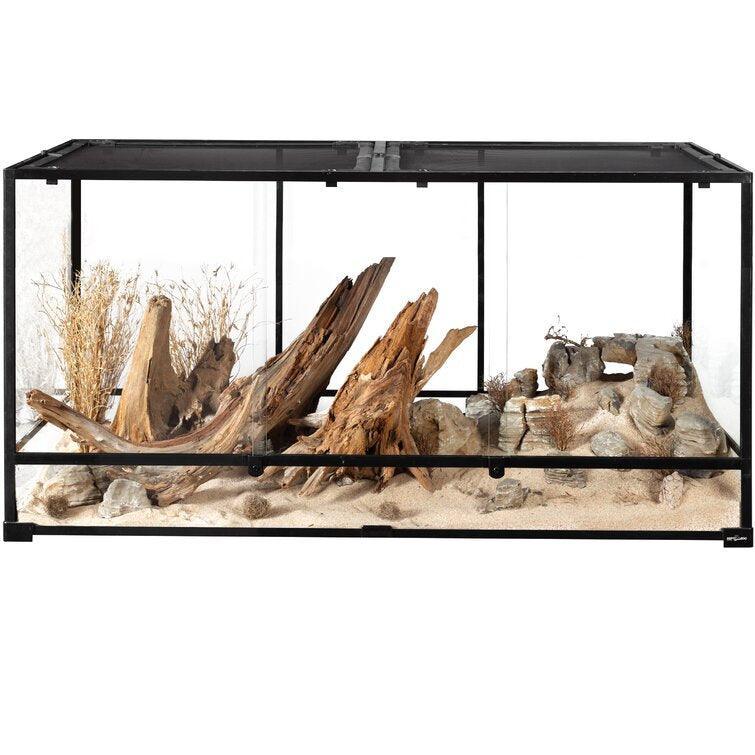
When you know the dimensions your boa needs, compare the current REPTIZOO snake enclosure options, step up to the 6x2x2 reptile enclosure collection when the individual snake's needs fit that footprint, and use the REPTIZOO custom snake enclosure pathway for adults whose measured size calls for more depth or usable height than standard products provide.
REPTIZOO Habitat Tip
A great reptile habitat starts with the right environment. Choose an enclosure that provides appropriate space, ventilation, lighting, temperature, and humidity for your reptile’s specific needs.
About REPTIZOO
REPTIZOO helps reptile keepers build complete habitats with thoughtfully designed terrariums, enclosures, lighting, heating, humidity control, and habitat accessories. Whether you're setting up a home for a bearded dragon, gecko, snake, chameleon, turtle, or other reptile, our goal is to make habitat building simpler, safer, and closer to nature.
Explore REPTIZOO habitat solutions and Live in Nature.