


Poison Dart Frog Enclosure: Size, Setup & Bioactive Terrarium Guide

A poison dart frog enclosure is a living system, not a fish tank with plants glued in. Whether the build works depends on usable dimensions, a functional drainage system, planted substrate that stays moist but not waterlogged, humidity management on top of appropriate top coverage, and — most importantly — the specific dart frog species you are planning around. Buying the tank first and figuring out the rest later is a common way these builds run into trouble.
This guide walks the decision in the order that tends to work: pick the species, size the enclosure to the group, choose an enclosure with the features a planted / bioactive build needs, layer drainage and substrate, install plants and cover, dial in moisture and top coverage, then match the plan to a specific REPTIZOO enclosure. At no point should the product dictate the husbandry.
Quick Answer: What Size Enclosure Does a Poison Dart Frog Need?
For many commonly kept setups, an 18" x 18" x 24" front-opening glass terrarium is a practical starting-point size class — but it is not a universal minimum. The right enclosure depends on the exact species, the number of frogs in the group, how much usable planted floor area the build will provide, and how the enclosure will be planted and furnished. Verify a specific range against a reliable source for the species you plan to keep.
Poison Dart Frog Enclosure Size: What Actually Matters?
Match the enclosure to the exact dart frog species
"Poison dart frog" covers species with meaningfully different housing needs. Dendrobates, Ranitomeya, Oophaga, Phyllobates, and other dart frogs vary in adult size, use of vertical structure, social behavior, and group tolerance. Start every enclosure decision with the exact species and use species-specific husbandry guidance rather than applying one housing formula to every dart frog.
Floor space vs vertical space
Some dart frogs spend most of their time on the ground moving between leaf litter, hides, and low cover. Others use branches, bromeliads, and vertical structure more heavily. Neither behavior is universal to "dart frogs" as a group.
-
Usable floor area determines how many frogs can move without constant interaction and how much dense planted cover the build can support.
-
Usable vertical structure — cork panels, mounted bromeliads, branches, and background plants — matters most for species that climb, but adds cover and visual barriers even for more terrestrial animals.
Design for the behavior of your specific species, then choose an enclosure whose dimensions support that behavior.
Group size changes the enclosure decision
There is no reliable fixed "gallons per frog" formula for dart frogs. A pair of small Ranitomeya use space very differently from a group of Dendrobates auratus. Group planning depends on the species, sex composition, social behavior, individual frog size, the enclosure's usable floor area, and how much visual separation the layout provides. Verify group-size guidance for the exact species you plan to keep rather than reusing a general number.
18x18x24 vs 36x18x24
Both are common size classes for planted / bioactive dart frog builds, and REPTIZOO produces terrariums in both formats.
-
18" x 18" x 24" — a compact, tall footprint that can work for appropriately selected species and group configurations, especially where vertical planting and background work carry much of the visual structure. It is also manageable to plant, mist, and maintain.
-
36" x 18" x 24" — twice the horizontal length at the same 18" depth and 24" height. Roughly doubles usable floor area and can support more planting, more visual barriers, more hardscape, and often more social flexibility for groups whose species tolerate it.
Neither is universally correct. Choose based on the species, group, and the planted layout you actually intend to build.

Best Enclosure Type for Poison Dart Frogs
Why front-opening access helps
Once a dart frog vivarium is planted, top-only access forces you to reach over lights, mist heads, and delicate foliage every time you go inside. Front-opening double doors simplify the parts of the build you actually do weekly — daily feeding without disturbing the canopy, pruning and replanting, adjusting or cleaning mist heads, spot-cleaning leaf litter, and repositioning cork bark and hardscape. Front access also reduces the odds of dropping tools into the substrate or startling frogs from directly above them.
Waterproof lower section and substrate depth
A planted / bioactive dart frog build needs vertical room below the visible substrate for a drainage layer, a substrate barrier, and enough bioactive substrate for plant roots. That requires an enclosure with an appropriately sealed, moisture-resistant lower section — a screen-heavy terrarium is generally not planted-vivarium-ready.
Do not assume every waterproof terrarium can hold arbitrary standing-water depth. Confirm the manufacturer-specified water-holding base height and keep any standing water in the drainage reservoir well within the enclosure's documented design limits.
Top coverage vs moisture retention
Poison dart frog husbandry commonly involves high ambient humidity, and many keepers deliberately restrict screen ventilation to hold it. Fully open mesh tops can make humidity difficult to maintain, so keepers often partially cover the screen with glass, acrylic, or plastic sheeting, or use enclosures with reduced top ventilation.
Top coverage is not a fixed rule. The appropriate amount depends on the species, room humidity, misting frequency, plant density, and enclosure design. The lever to adjust is usually top coverage — increase it if the enclosure dries too quickly between mistings, reduce it if condensation and standing surface moisture persist for too long. Adjust based on measured enclosure conditions rather than a universal target.
Note that high humidity and permanently waterlogged substrate are different problems. Substrate that stays saturated points to drainage design, over-misting, or a clogged drainage layer — not to a lack of airflow.
Why dimensions matter more than gallon labels
Two "29-gallon" tanks can have very different footprints. For a dart frog build, gallon capacity tells you almost nothing useful. Compare length × depth × height in inches, look at where the doors and vents sit, confirm the waterproof lower section, and only then think about "gallons."
What to Look for in a Dart Frog Terrarium
| Feature | Why It Matters | What to Check |
|---|---|---|
| Front opening | Simplifies feeding, pruning, mist-head service, and spot cleaning without reaching over plants | Front-opening doors (hinged or sliding); usable clearance for your hand and tools |
| Usable dimensions | Determines planted floor area, canopy volume, and hardscape space | Length × depth × height in inches; not gallons |
| Water-resistant lower section | Allows a drainage layer and moisture-retentive substrate without leaks | Manufacturer-specified waterproof / raised base and its documented height |
| Substrate depth | Supports drainage layer + separator + planted substrate + leaf litter | Enough sealed lower height for all four in the layout you plan |
| Top coverage | Balances humidity retention against surface moisture | Screen top compatible with partial glass / acrylic coverage; adjustable to enclosure conditions |
| Misting access | Determines whether an automated or hand-mist setup can be plumbed in cleanly | Cable / tubing pass-throughs and top screen compatibility |
| Lighting access | Determines whether plant lighting sits above mesh or inside the enclosure | Compatible top; clearance for the fixture you plan to use |
| Plant / hardscape space | Determines what the finished build can actually hold | Room for background, mounted bromeliads, cork panels, and canopy plants |
Recommended REPTIZOO Enclosures for Poison Dart Frogs
The best enclosure depends on the species and the layout you intend to build. Two REPTIZOO size classes are commonly used for dart frog vivariums.
Best Starting-Point Option: REPTIZOO 18" x 18" x 24" Front-Opening Glass Terrarium
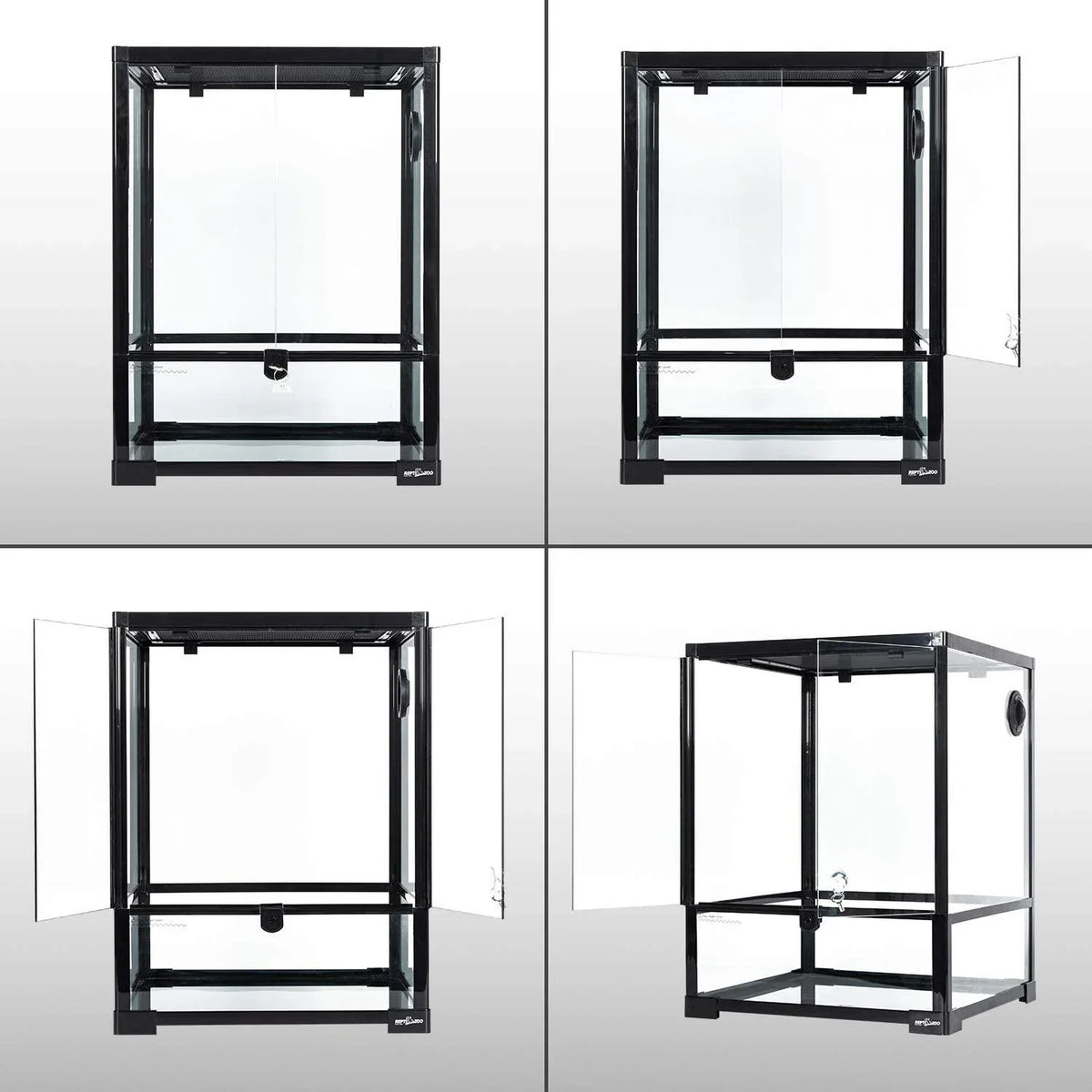
The REPTIZOO RK0110 is an 18" x 18" x 24" front-opening tempered glass terrarium with two independently opening front doors, a removable screen top, and a raised waterproof bottom. On its official product page it is described for tropical / rainforest / amphibious setup categories, which lines up with a planted dart frog build.
Practical strengths for a dart frog vivarium: the 24" height leaves room for a drainage layer, a substrate barrier, planted substrate, leaf litter, and a canopy above; the two independently opening front doors keep daily feeding and weekly maintenance manageable; the removable screen top allows plant lighting and can be partially covered to help hold humidity; and the raised waterproof bottom supports a moisture-retentive build without turning the enclosure into a leak risk.
Important caveat: the enclosure does not automatically maintain dart-frog humidity on its own. Actual humidity retention depends on top coverage, room climate, planted density, misting frequency, and the complete setup. Match the setup to your species' published husbandry guidance.
Product page: [https://reptizoo.store/products/30-gallon-front-opening-desert-lizard-tank-18-x-18-x-24-reptile-terrarium]
Larger Planted Option: REPTIZOO 36" x 18" x 24" Size Class
A 36" x 18" x 24" enclosure roughly doubles the usable floor area at the same 18" depth and 24" height as the 18x18x24. That extra horizontal room can support:
-
Expanded planted layouts with more foreground / midground / background zoning.
-
More usable floor area for terrestrial species.
-
More visual barriers and hardscape breaks between areas of the enclosure.
-
More cork bark, driftwood, and mounted planting.
-
Appropriately sized species / group setups where the animals actually need the extra floor space.
A larger enclosure is not universally better. Additional volume also means more planting, misting, and lighting to manage, and a sparsely furnished larger enclosure may not use its extra room effectively. Choose it because the species and layout call for it.
For availability of the 36" x 18" x 24" size class, browse the current REPTIZOO frog terrariums — specific 36x18x24 SKUs may go in and out of stock.
When a Different Enclosure May Make More Sense
Species and keeper conditions can override generic product recommendations. A compact species or pair may use an 18x18x24 differently from a larger or more terrestrial group. Room climate, ambient humidity, lighting, plant density, and the keeper's maintenance routine can also change how a given enclosure performs. If the standard sizes do not fit the species or planned group, choose a different enclosure rather than forcing the setup into the wrong footprint.
Poison Dart Frog Enclosure Size Planning
| Setup / REPTIZOO Size | Useful For | Main Advantage | Important Caveat |
|---|---|---|---|
| REPTIZOO 18" x 18" x 24" | Compact planted / bioactive builds for appropriately sized species and groups | Front-opening double doors and raised waterproof base at a manageable footprint | Not a universal minimum for every species; group size still matters |
| REPTIZOO 36" x 18" x 24" | Larger planted layouts, more visual barriers, and groups that need more floor area | Roughly doubles horizontal floor area at the same depth and height | More volume to plant, mist, and light; specific 36x18x24 SKUs may vary in availability |
CTA: Once you know the species, group size, and planted layout your build needs, browse the current REPTIZOO frog terrariums and compare the 18x18x24 front-opening glass terrarium with the 36" x 18" x 24" size class.
Poison Dart Frog Enclosure Setup Checklist
CHECKLIST 1 — Before Buying the Enclosure
-
Exact species identified; locality or morph noted only when it materially changes husbandry guidance.
-
Species-specific husbandry guidance reviewed for enclosure dimensions, group size, temperature, humidity, and lighting.
-
Group composition planned (sex, number, individual origins).
-
Usable dimensions (length × depth × height) chosen to fit the species and group — not chosen by gallon label.
-
Waterproof lower section confirmed against the manufacturer's documented water-holding base height.
-
Front-opening access confirmed for the planted layout you plan to maintain.
-
Top coverage plan sketched — how the screen top will be partially covered or otherwise adjusted to hold humidity.
-
Room climate assessed for baseline ambient temperature and humidity.
CHECKLIST 2 — Before Adding the Frogs
-
Drainage layer / false bottom installed.
-
Substrate barrier in place.
-
Bioactive substrate installed at appropriate depth for the plants.
-
Leaf litter added across the substrate for cover and microfauna.
-
Live plants and cork / hardscape installed and stable.
-
Hides / visual barriers distributed across the floor.
-
Misting system installed and tested (or hand-mist routine planned).
-
Digital thermometer and hygrometer installed at frog level and reading stable.
-
Lighting for plants set on a timed day / night cycle.
-
Top coverage tuned; enclosure holds humidity in the target range without persistently saturated substrate.
-
Microfauna (springtails, isopods where appropriate) seeded and established.
-
Species-specific husbandry parameters confirmed before frogs are introduced.
Build the Drainage and Substrate Layers

A dart frog vivarium is built from the bottom up.
1. Drainage Layer or False Bottom
The drainage layer sits directly on the enclosure floor and gives excess water somewhere to go instead of sitting in the substrate. Two common approaches:
-
Lightweight drainage aggregate — LECA (expanded clay), pumice, or a similar lightweight porous material.
-
False bottom grid — a rigid platform raised above the enclosure floor, creating an air/water space beneath the planted substrate.
Either approach works when installed correctly. The depth depends on the enclosure's waterproof-base height and how much standing water the design allows without approaching door tracks or vents. There is no single mandatory drainage depth for every build.
2. Substrate Barrier
A permeable barrier — mesh, weed fabric, or a purpose-made substrate divider — sits between the drainage layer and the substrate above. Its purpose is simple: keep fine soil particles out of the drainage layer so it does not clog and can keep moving water down.
3. Bioactive Substrate
The planted substrate carries the plants and hosts the microfauna. A dart-frog-appropriate mix generally balances moisture retention (so the enclosure stays humid), aeration (so roots don't rot), and enough structure for plants to anchor. Depth depends on the plants you plan to root directly into it — background epiphytes need less, larger terrestrial plants need more. No single substrate formulation is universally required; several established mixes are used successfully.
4. Leaf Litter
A dense layer of dried tropical leaf litter (magnolia, sea grape, live oak, and similar species commonly used for vivariums) sits on top of the substrate. It provides cover for the frogs, feeding surface and habitat for the cleanup crew, and a naturalistic look. Leaf litter is usually added generously — a thin decorative sprinkle behaves differently.
A moss carpet can complement leaf litter but does not deliver the same cover, microfauna habitat, or hunting surface. Moss works well as a supplement rather than a substitute.
Bioactive Enclosure Layers
| Layer | Function | Common Mistake |
|---|---|---|
| Drainage layer / false bottom | Holds excess water below the substrate, helps prevent waterlogging | Skipping the layer entirely, or letting it fill so high it saturates the substrate above |
| Substrate barrier | Keeps fine soil out of the drainage layer | Omitting the barrier — substrate can then clog the drainage layer over time |
| Bioactive substrate | Roots plants, retains moisture, hosts microfauna | Using a compacting or overly wet mix that turns anaerobic |
| Leaf litter | Cover for frogs, habitat and feeding surface for microfauna | Sprinkling a thin decorative layer instead of a genuine litter carpet |
Plants, Hides and Hardscape
Dense Plant Cover
Dart frogs use cover frequently. Dense planting across the enclosure — foreground, midground, and background — provides shelter, usable microhabitats, and visual separation between individuals. Many dart frog keepers plant heavily for this reason. Sparse "display" planting with lots of open ground can leave less usable cover, though the effect on any individual frog depends on species and setup.
Bromeliads and Tropical Plants
Bromeliads are common in dart frog vivariums because they add cover and usable structure, and some dart frog species also use plant-held water during reproduction. Ferns, pothos, small tropical foliage plants, and mosses can round out a planted build. Choose plants that tolerate the humidity, lighting, and available space in your enclosure, and avoid letting failed foliage accumulate as decaying material.
Cork Bark, Branches and Visual Barriers
Cork bark tubes, slabs, and flats do double duty as hides and as vertical / horizontal structure. Sturdy branches — anchored so they cannot shift — extend usable habitat and give the frogs sight-line breaks. Visual barriers can help reduce repeated interactions in species or groups where territorial or social pressure is a concern.
Keep Usable Floor Space
A planted vivarium can look impressive on install day and become almost unusable at the frog level six weeks later, once every plant has filled in. Design with the six-months-out version in mind: leave real floor area between plantings, keep leaf litter accessible, and prune when foliage crowds out the ground. A dart frog vivarium's job is to be habitable, not photogenic.
Humidity, Top Coverage and Misting

Think in Moisture Cycles, Not One Permanent Number
Dart frog humidity targets vary by species and husbandry framework. Rather than chasing one fixed RH percentage indefinitely, many setups run in cycles — higher humidity after misting, then some surface drying before the next mist. Use species-specific guidance for the target range and measure conditions with a digital hygrometer at frog level rather than only near the top screen.
Why Top Coverage Matters
Fully open mesh tops release humidity quickly and can make the target range difficult to maintain. Many dart frog keepers cover a portion of the screen with glass, acrylic, or plastic sheeting to hold humidity, and adjust the coverage based on measured enclosure conditions. Some specialist husbandry sources deliberately restrict airflow for the same reason. The appropriate amount of coverage depends on species, room humidity, misting frequency, plant density, and enclosure design.
Misting vs Waterlogged Substrate
Humid air is not the same as saturated substrate. Frequent misting keeps the canopy and leaf litter moist and raises ambient humidity; substrate that never dries usually points to over-misting, insufficient drainage, or both. If the drainage reservoir constantly holds water above the false bottom, mist less or drain the reservoir.
Prevent Waterlogging
Persistent waterlogging often points to drainage design, misting frequency, substrate structure, or a combination of these factors. A functioning drainage layer, substrate barrier, and well-draining planted substrate help keep the root zone from remaining saturated. If water repeatedly reaches the substrate above the drainage layer, address the water balance before simply opening more mesh on top.
Water Inside a Dart Frog Enclosure
Poison dart frogs are not aquatic frogs, and a large aquatic section is usually unnecessary for a typical poison dart frog vivarium.
Practical water considerations:
-
Water quality. Use water appropriate for amphibian enclosures. If tap water contains chlorine or chloramine, treat it appropriately before it reaches the frogs or planted habitat.
-
Misting water. Automated systems commonly use RO or dechlorinated water; hand-mist setups can too. Do not spray untreated tap water on plants and animals without confirming its suitability.
-
Drainage reservoir. The water that collects below the false bottom is functional, not decorative. Keep it below the substrate level and drain it during maintenance.
-
Shallow, accessible water — if appropriate. Some builds include a small water feature that is easy for frogs to enter and exit and easy for the keeper to service. A large aquatic section is usually unnecessary in a typical dart frog vivarium.
Deep open water sections are not a default recommendation for a typical dart frog vivarium.
Temperature, Lighting and UVB
Avoid Overheating the Vivarium
Heat spikes can become dangerous for many dart frog species, so enclosure temperatures should be checked against guidance for the exact species. Direct sunlight on a glass enclosure can raise interior temperatures quickly, and high-wattage lighting can heat the canopy well beyond what the frogs tolerate. Position the enclosure away from windows that catch direct sun, and monitor canopy temperatures once the lights are running.
Lighting for Plants and a Day/Night Cycle
Plant lighting and animal lighting are related but not identical questions. Plants need enough intensity and appropriate spectrum to grow through the canopy; frogs need a consistent day / night cycle and, in some care frameworks, appropriate UVB. Use a timer for the plant-lighting cycle so day length stays consistent, and monitor canopy temperatures once the lights are running.
Do Poison Dart Frogs Need UVB?
Dedicated UVB use for poison dart frogs is not universally agreed upon. Some current husbandry frameworks recommend carefully controlled low-level UVB. Other experienced dart frog keepers keep dart frogs successfully without dedicated UVB when appropriate dietary vitamin D3 supplementation is managed, and published research has shown behavioral avoidance of higher UV-B exposure in some poison frog species.
Because UVB output, mesh, distance, shade, and species all affect exposure, keepers should follow a species-appropriate husbandry framework rather than treating one rule as universal. This enclosure article does not prescribe a specific UVB bulb, UVI target, distance, or photoperiod.
Bioactive Cleanup Crew
Springtails
Springtails are widely used in dart frog bioactive vivariums as a cleanup crew and as supplementary prey. They process mold, uneaten food, and other organic material. Seed springtail populations before adding frogs so the colony is established.
Isopods
Terrestrial isopods can help break down leaf litter and larger organic material. Small-bodied species are commonly used in dart frog vivariums, but cleanup-crew choice should match the enclosure and frog species rather than following a universal list.
Bioactive Does Not Mean Maintenance-Free
Bioactive vivariums shift maintenance rather than eliminate it. Even an established system still benefits from routine observation, plant pruning, leaf-litter top-ups, drainage checks, and cleanup-crew monitoring.
Do Poison Dart Frogs Need a Paludarium?
Usually no. A planted dart frog vivarium — humid, well-drained, densely planted, with leaf litter cover — is what most dart frog builds actually are. A true paludarium with a meaningful aquatic zone is a different kind of enclosure, and adding a large body of water to a dart frog setup is usually unnecessary.
For most keepers and most species, the right build is a planted vivarium with good drainage and controlled humidity. If a paludarium-style build genuinely fits your species and design — and you have the maintenance capacity for a real aquatic section — the paludarium setup guide covers land-and-water builds in depth.
Common Poison Dart Frog Enclosure Mistakes
-
Buying based only on gallon capacity instead of dimensions and enclosure features.
-
Assuming one enclosure size fits every dart frog regardless of species and group size.
-
No drainage plan — planting straight into substrate on the enclosure floor.
-
Permanently waterlogged substrate from over-misting or a clogged drainage layer.
-
Top coverage set without measurement — either drying the enclosure out or leaving surfaces persistently wet, without adjusting to actual conditions.
-
Excessive or deep exposed water in a setup that does not need it.
-
Overheating from direct sun or high-wattage lighting on a sealed glass enclosure.
-
Overcrowding without species-specific group-size guidance.
-
Mixing species without species-specific research and dedicated enclosure planning.
-
Adding frogs before the enclosure setup is ready — before drainage, planting, humidity, and microfauna are stable.
-
Assuming bioactive means maintenance-free and neglecting observation, pruning, and reservoir management.
Poison Dart Frog Enclosure Maintenance
Daily Observations
Look at every frog. Confirm normal posture, movement, and appetite. Check the enclosure's humidity and temperature readings at frog level. A daily thirty-second scan catches problems that a monthly deep-clean does not.
Drainage and Water Management
Check the drainage reservoir routinely. Drain excess water when it rises toward the substrate level, and confirm the substrate above is moist but not saturated. Adjust misting frequency if the reservoir fills faster than expected.
Leaf Litter and Plant Maintenance
Top up leaf litter as it breaks down. Prune plants when foliage crowds out the ground or blocks light from lower zones. Remove dead leaves and any obvious mold outbreaks.
Monitoring the Cleanup Crew
Look for springtails on the substrate and isopods in the leaf litter. If populations noticeably dip, top them up. If populations expand in a way that seems abnormal, look for the underlying cause — often excess uneaten food.
Do not schedule full substrate replacements at arbitrary intervals for a functioning bioactive system. Replace substrate when a specific problem calls for it (compacted, anaerobic, contaminated), not on a calendar.
FAQs About Poison Dart Frog Enclosures
1. What size enclosure does a poison dart frog need?
It depends on the exact species, group configuration, and how the enclosure will be planted and furnished. For many commonly kept setups, an 18" x 18" x 24" front-opening glass terrarium is a practical starting-point size class, while a 36" x 18" x 24" footprint provides more usable floor area and layout flexibility. Species-specific guidance should still determine the final choice.
2. Is an 18x18x24 terrarium good for dart frogs?
An 18" x 18" x 24" front-opening glass terrarium is a common, practical starting-point size class for many dart frog builds when it is properly planted, drained, and matched to the species and group. It is not a universal minimum, and larger sizes suit species that need more floor space or larger groups.
3. Do dart frogs need more floor space or height?
It depends on the species. Some dart frogs are more terrestrial and use floor space intensively; others use vertical structure, bromeliads, and branches more heavily. Most healthy builds provide both — usable floor area with cover, plus mounted planting and hardscape that extends the habitat upward.
4. Do poison dart frogs need a bioactive enclosure?
Bioactive is not the only approach, but it is very popular for dart frogs because it can help manage moisture, break down waste, and provide supplementary prey via microfauna. Non-bioactive setups can work with the right maintenance schedule. Bioactive setups still require monitoring, pruning, and drainage management.
5. How humid should a poison dart frog enclosure be?
Poison dart frogs generally need high humidity, but a single universal RH target does not fit every species. Humidity targets, misting frequency, and top coverage should follow guidance for the specific species you keep, and be tuned to what a digital hygrometer measures at frog level rather than what a fixed number prescribes.
6. Do dart frogs need a heat lamp?
Many dart frog setups rely on suitable ambient room temperature and do not use a dedicated heat lamp. Supplemental heating should be used only when the intended species and the room's baseline temperature genuinely require it, and should be carefully controlled to avoid heat spikes. Verify a safe temperature range for the specific species before adding any heat source.
7. Do poison dart frogs need UVB?
Guidance differs. Some current husbandry frameworks recommend carefully controlled low-level UVB; other experienced keepers do not consider dedicated UVB necessary when supplementation is properly managed, and published research shows behavioral avoidance of higher UV-B exposure in some poison frog species. Follow a species-appropriate framework rather than treating one rule as universal.
8. Can poison dart frogs live in a paludarium?
A planted dart frog vivarium — humid, well-drained, densely planted — is generally a better fit than a true paludarium with a meaningful aquatic zone. Poison dart frogs are not aquatic frogs, and deep open water is usually unnecessary. Only build a paludarium-style enclosure if the species and design genuinely call for it.
9. How many poison dart frogs can live in one enclosure?
There is no reliable universal number. Stocking depends on the exact species, sex composition, social behavior of that species, enclosure dimensions, and how well the layout provides visual barriers between frogs. Verify group-size guidance for the specific species you plan to keep rather than reusing a general "gallons per frog" rule.
Sources & Further Reading
-
Josh's Frogs — Making a Glass Top — practical guidance on reducing top ventilation to retain humidity in dart frog vivariums.
-
Josh's Frogs — How to Know Your Dart Frog Vivarium Is Ready for Frogs — checklist-oriented guidance for temperature, humidity, microfauna, plants, and enclosure readiness.
-
Understory Enterprises — Dart Frog Care — specialist dart frog husbandry covering humidity, temperature, lighting, and vivarium construction.
-
World Wildlife Fund — Green-and-Black Poison Dart Frog — species-specific care considerations, including temperature, humidity, and low-level UVB guidance.
-
Han et al. (2007), Biotropica — Behavioral Avoidance of Ultraviolet-B Radiation by Two Species of Neotropical Poison-Dart Frogs — peer-reviewed field and experimental research on UV-B avoidance behavior in two poison frog species.
-
REPTIZOO Frog Terrariums and REPTIZOO RK0110 18" x 18" x 24" Terrarium — official REPTIZOO pages for product dimensions, availability, and enclosure features cited in this guide.
Different dart frog species can require different enclosure dimensions, social arrangements, temperatures, and environmental parameters. Use species-specific husbandry guidance when finalizing a setup.
Build the Enclosure Around the Frogs, Not the Tank Label
A poison dart frog enclosure works best when the decision runs in this order: species → dimensions → drainage → planting → moisture and top coverage → product choice. Starting with the enclosure alone can force the rest of the habitat plan to compensate for a footprint or feature set that never matched the frogs in the first place.
Start with the exact species. Match the enclosure dimensions to what that species and group actually need. Build the drainage system before the substrate, plant densely enough to give the frogs real cover, and tune humidity and top coverage to what your digital hygrometer measures rather than to a single fixed number.
When the plan is on paper and the requirements are clear, browse the current REPTIZOO frog terrariums — including the 18x18x24 front-opening glass terrarium for compact planted builds and the 36" x 18" x 24" size class for larger planted layouts — and choose the enclosure that fits your dart frogs, not the other way around.
REPTIZOO Habitat Tip
A great reptile habitat starts with the right environment. Choose an enclosure that provides appropriate space, ventilation, lighting, temperature, and humidity for your reptile’s specific needs.
About REPTIZOO
REPTIZOO helps reptile keepers build complete habitats with thoughtfully designed terrariums, enclosures, lighting, heating, humidity control, and habitat accessories. Whether you're setting up a home for a bearded dragon, gecko, snake, chameleon, turtle, or other reptile, our goal is to make habitat building simpler, safer, and closer to nature.
Explore REPTIZOO habitat solutions and Live in Nature.