


Corn Snake Temperature: Ideal Day & Night Ranges and Heating Setup

The right corn snake temperature is a gradient, not one number. Commonly cited starting points include a basking surface of about 85–90°F (29–32°C) and a cooler zone around 72–78°F (22–26°C), with a separately monitored warm-end basking zone. At night, turn off light-producing heat and monitor the temperature drop according to a husbandry plan appropriate to your snake and room. Measure each zone separately rather than relying on one reading near the lamp.
What Is the Ideal Corn Snake Temperature?
Corn Snake Temperature Chart: Basking, Warm Side, Cool Side, and Night
Table 1: Corn Snake Temperature Quick Reference
| Temperature Zone | Practical Starting Reference | What to Measure |
|---|---|---|
| Basking surface | About 85–90°F (29–32°C) | The basking surface directly beneath the daytime heat source; use an infrared thermometer and/or appropriately secured surface probe. |
| Basking zone at snake height | About 82–86°F (28–30°C), using the RSPCA's measurement method | Check the basking zone with a digital thermometer, with the probe just above the substrate where the snake rests. This is not a universal temperature target for all warm-side air. |
| Cool end | About 72–78°F (22–26°C) as one practical reference | Measure near snake level or at the substrate on the far side of the enclosure, consistently using the same method. |
| Night | No single agreed minimum; see the nighttime guidance below | Record overnight lows with an appropriately placed min/max thermometer; maintain a usable temperature gradient. |
These are starting references, not universal thresholds. ReptiFiles gives a 90°F basking surface and 75–82°F cool zone; Phoenix Herpetological Society describes 85–90°F basking and 72–78°F cool-side conditions. The RSPCA gives 28–30°C at the basking zone with its probe just above the substrate and 20–24°C at the cool end. The Royal Veterinary College describes approximately 30°C as a basking temperature, not an independent ambient-air target. A thermostat setpoint is the target at the controller's probe, not proof that every zone is correct.
Surface Temperature vs. Air Temperature: What's the Difference?
A basking surface reading is the temperature of the rock, branch, or substrate under the heat source that your snake's body contacts. An air reading is the air temperature at a spot, usually at snake height. Surfaces under a lamp absorb radiant heat and usually read warmer than the air, which is why they have different targets. One thermometer near the lamp can't tell you whether the cool side is cool, so measure both ends.
How to Create a Temperature Gradient in a Corn Snake Enclosure
Step 1: Position the Heat Source on One Side
Place the main heat source at one end, pointing downward, as the RSPCA describes (RSPCA). ReptiFiles recommends mounting lamps on top of the enclosure in ceramic sockets rather than inside, since young corn snakes can work their way into bulb cages (ReptiFiles). Any lamp inside the enclosure needs a guard, as the RSPCA and RVC advise.
Step 2: Create a Warm Side and Basking Spot
Place a flat rock, slate, or sturdy branch under the heat source. Then check the basking surface and the hot-end air at snake height separately against Table 1.
Step 3: Keep the Opposite Side Cooler
The cool side lets your snake shed excess heat. Keep the enclosure away from radiators, drafts, and direct sunlight, which the RSPCA notes alter temperatures.
Step 4: Add Hides and Safe Climbing Areas
Place a hide on each side so your snake never has to choose between security and temperature. Keep branches from bringing the snake within reach of any bulb or fixture.
Step 5: Monitor and Adjust the Temperatures
ReptiFiles recommends setting up at least a week before your snake arrives. Change one variable at a time, and let conditions settle before rechecking.
How to Heat a Corn Snake Tank Safely
Overhead Heat Lamps
ReptiFiles ranks halogen or incandescent heat lamps mounted on top of the enclosure as its preferred daytime heat. Use a fixture and socket rated for the bulb, and guard any reachable lamp. The right wattage depends on enclosure size, mounting distance, and room temperature (PetMD). For light-producing bulbs, ReptiFiles advises a dimming or proportional thermostat rather than an on/off type (ReptiFiles).
Heat Mats and Their Limitations
ReptiFiles says a heat mat should never be the primary heat source; the RSPCA describes one as an option for small hatchling enclosures. Mats mainly warm the surface they contact, so they may not create a full air gradient. Use a thermostat rated for the mat, and install it exactly as the manufacturer specifies, never inside the enclosure or under substrate unless explicitly allowed.
Ceramic Heat Emitters and Nighttime Heating
Ceramic heat emitters produce heat without visible light, so they suit supplemental nighttime heat. The RSPCA and RVC both list them as options. They get very hot, so use a ceramic socket, a guard if reachable, and a thermostat the manufacturer confirms is compatible.
Which Heating Method Works Best for Your Setup?
No method suits every enclosure:
- Daytime basking: an overhead heat lamp is the usual primary source.
- Overnight supplemental heat: a ceramic heat emitter or correctly installed heat mat, only if lows fall below your target.
- Small enclosures and hatchlings: the RSPCA describes a thermostat-controlled heat mat as an option; measure air temperatures too.
- Thermostat compatibility: match thermostat type to the heater; ReptiFiles advises dimming or proportional control for light-producing bulbs.
- Installation safety: follow each manufacturer's instructions for fixtures, mounting, and guards.
Table 2: Heating Method Comparison
| Heating Method | Typical Use | Advantages | Limitations | Safety Requirements |
|---|---|---|---|---|
| Overhead heat lamp | Daytime basking and hot-end heat | Creates a basking surface and warm air zone | Emits light, so it goes off at night; wattage must fit the setup | Rated fixture, guard if reachable, compatible thermostat |
| Heat mat | Supplemental heat; small or hatchling setups | Low profile; steady surface heat | May not heat the air enough; not a primary source per ReptiFiles | Thermostat rated for the mat; manufacturer installation only |
| Ceramic heat emitter | Supplemental or nighttime heat | No visible light | Gets very hot; no lit basking spot | Ceramic socket, guard, compatible thermostat |
Once you've chosen a method, browse REPTIZOO's reptile heat lamps and match wattage to your enclosure, room, and fixture rating.

Do Corn Snakes Need Heat at Night?
Understanding Safe Nighttime Temperature Drops
Switch off visible heat lamps at night. A natural dark period supports a normal day–night rhythm, and colored "night" bulbs still emit light. Most sources accept some overnight drop, but they disagree on how far:
Table 3: Published Nighttime Guidance
| Source | Nighttime Guidance |
|---|---|
| RSPCA | Heat lamp off; temperatures can drop to 16–20°C (61–68°F). Add non-light-emitting heat if the room gets colder. |
| ReptiFiles | Room temperature or about 75°F (24°C); heat usually off for adults; keep hatchlings under one year warm. |
| Royal Veterinary College (2024) | Thermostat-controlled background heat so the overnight temperature doesn't drop below about 24°C (75°F). |
The differences reflect distinct husbandry approaches, not a menu of interchangeable safe minimums. The RSPCA's lower nighttime range assumes the normal household conditions it describes; the Royal Veterinary College recommends a warmer, thermostat-controlled background. A figure from either source should not be presented as universally safe for every snake. Once the daytime lamp is off, room temperature and any separate background heater determine the overnight conditions, so measure first.
When Supplemental Nighttime Heat May Be Needed
Use this decision process:
- Measure first. Record nighttime minimums in the enclosure over several nights, particularly during colder weather.
- Set a consistent care plan. Compare published guidance with the animal's age and circumstances rather than picking the lowest number from a table. The RVC's approximate 75°F (24°C) overnight background target is a more conservative reference; the RSPCA describes a lower nighttime range under normal household conditions. If uncertain which approach suits your animal, consult a reptile-experienced veterinarian.
- Consider hatchlings separately. ReptiFiles advises keeping hatchlings under one year warm at night; don't assume adult nighttime practices apply to them.
- Check whether extra heat is needed. If the measured overnight conditions fall below the target for the care plan, use an appropriately installed, non-light-emitting source under a compatible thermostat, while preserving a cooler retreat.
- Retest. Confirm the overnight low and daytime temperature gradient again after any change.
If your snake shows persistent lethargy, poor appetite, or other unusual behavior despite stable readings, consult a reptile-experienced veterinarian. For broader husbandry, see our corn snake care guide.
How to Measure and Control Corn Snake Tank Temperature
Where to Place Thermometers
Place digital probes at both ends. ReptiFiles puts one on the basking surface and one on the cool-zone substrate. The RSPCA recommends digital thermometers at the cool end and the basking zone, checked daily.
How to Set Up a Thermostat and Probe
A thermostat adjusts or switches the heat source to hold its setpoint at the probe. Place the probe in the zone it controls, per the manufacturer's instructions; for a heat lamp, the RSPCA puts it just above the substrate at snake height. Secure it so the snake can't move it. Because thermostats can be inaccurate (RSPCA), verify with an independent thermometer, adjust, and retest. A thermostat reduces but doesn't eliminate burn or overheating risk.
How to Check Basking Surface Temperatures
An infrared temperature gun reads the surface it's pointed at, so it's useful for the basking spot. It doesn't measure air, and readings can vary with the surface material. Use it alongside probes, as the RSPCA suggests.
A Simple 24-Hour Temperature Monitoring Routine
During setup and after any equipment change:
- Morning: confirm both ends are warming.
- Midday: record stable hot-end and cool-side readings and check the basking surface.
- Evening: confirm there are no spikes before lights off.
- Overnight: capture the low with a min/max thermometer.
- Over several days: watch for changes linked to room heating, sunlight, or weather.
Does Enclosure Size Affect Corn Snake Temperature?
Why Floor Space Matters for a Heat Gradient
A longer enclosure separates warm and cool ends more clearly, but size alone doesn't create a safe gradient. Heat source, placement, ventilation, and room temperature all matter. The RSPCA emphasizes dimensions that let the snake stretch out (RSPCA). Our corn snake tank size guide covers size choices in detail.
Temperature Setup in 36" × 18" × 18" and 48" × 24" × 24" Enclosures
A 36" × 18" × 18" enclosure is a conditional option, depending on the snake's actual length and growth stage. It isn't an adequate adult size for every corn snake. Its shorter length makes the cool side more likely to warm up.
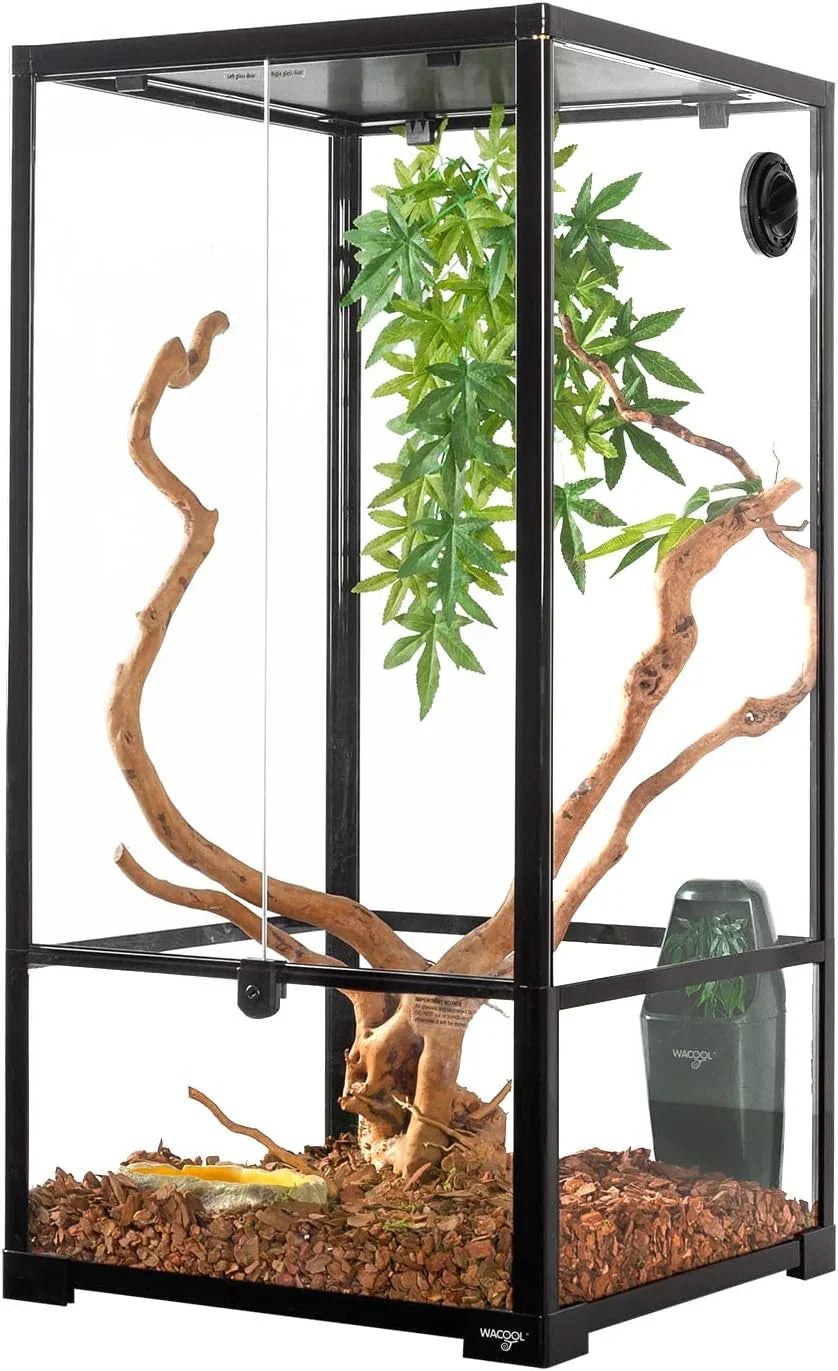
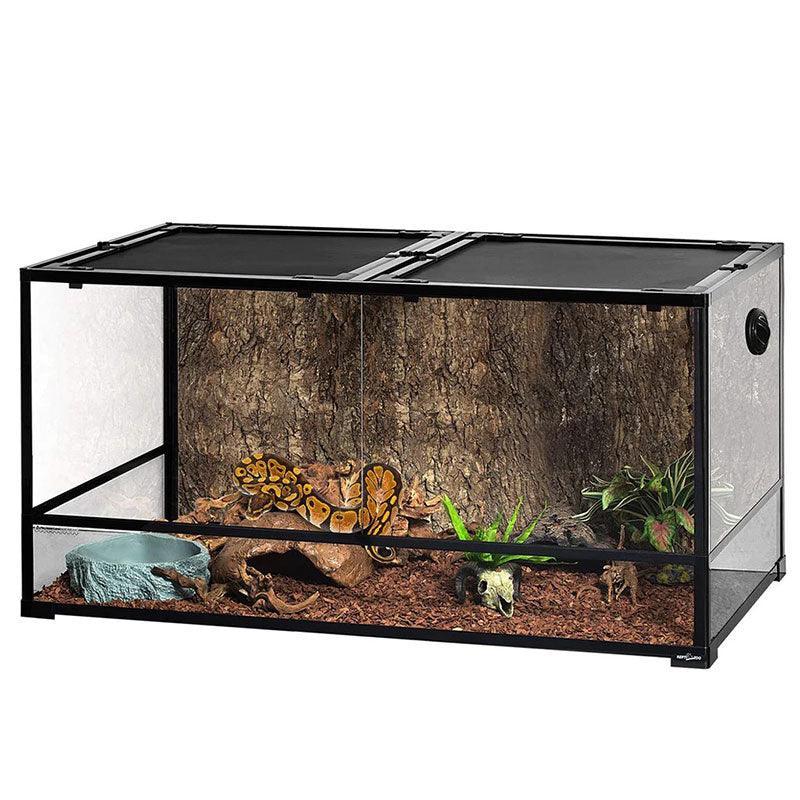
A 48" × 24" × 24" enclosure is a stronger choice for many adult setups, and the RVC's 2024 care sheet lists it as a minimum. It gives clearer zone separation and room for hides on both sides, though it may need more heat output.
Table 4: Enclosure Size and Heating Layout Considerations
| Enclosure | Floor Space | Gradient Separation | Heating Considerations | Best Fit |
|---|---|---|---|---|
| 36" × 18" × 18" | 648 sq in | Shorter; cool side may warm | One heat source at one end; watch cool-side readings | Conditional, based on snake length and growth stage |
| 48" × 24" × 24" | 1,152 sq in | Clearer separation | May need more output; verify both ends | Many adult setups |
When a Larger Enclosure May Be Worth Considering
Consider one if your snake can't stretch out, you can't fit separate hides, or the cool side keeps reading too warm. Look for secure doors, since corn snakes are capable escape artists.
Common Corn Snake Temperature Problems and Fixes
For each problem, use the same sequence: identify the symptom, measure it, investigate the cause, make a safe correction, and retest. If a fixture presents an immediate burn hazard or temperatures are dangerously high, remove the hazard promptly rather than waiting for readings to settle. For routine tuning, allow readings to stabilize and verify conditions again through the normal day–night cycle.
The Warm Side Is Too Cold
Measure the basking surface and hot-end air. Likely causes: low wattage, an aging bulb, a cold room, or a probe too close to the heat. Correct by repositioning the probe, raising output within the fixture's rating, or adjusting the setpoint, then retest.
The Basking Spot Is Too Hot
Measure the surface with an infrared thermometer and the air at snake height. Likely causes: wattage too high, or a probe that has moved away from the controlled zone. Correct by repositioning the probe, lowering setpoint or wattage, or raising the fixture only if it's designed for adjustable mounting, then retest.
The Cool Side Is Too Warm
Measure both ends at the same time. Likely causes: output too strong for a short enclosure, a warm room, or a heat source not at one end. Correct by reducing output or concentrating heat at one end, or consider a longer enclosure, then retest.
Temperatures Drop Too Much at Night
Measure with a min/max thermometer over several nights. Likely causes: a cold room or seasonal change. Correct with thermostat-controlled, non-light-emitting heat as described in the night section, then retest.
Thermostat Readings Don't Match Thermometer Readings
Measure both devices at the same spot, remembering surface and air readings differ. Likely causes: different positions or an inaccurate device. Correct by matching placement and comparing with a second thermometer; use a calibration offset if your device has one, otherwise replace a unit that consistently disagrees. Then retest.
Table 5: Troubleshooting Temperature Problems
| Problem | Possible Cause | What to Check | Suggested Action | Safety Note |
|---|---|---|---|---|
| Warm side too cold | Low wattage, aging bulb, cold room, probe too close to the heat | Surface and air readings; probe position | Reposition the probe; raise output within ratings; retest | Don't exceed fixture ratings |
| Basking spot too hot | High wattage; probe moved away from the controlled zone | Surface reading, probe position | Re-secure the probe; lower wattage or setpoint | Reposition fixtures only if designed for it |
| Cool side too warm | Output too strong, warm room, short enclosure | Both ends at the same time | Reduce output; concentrate heat at one end | Keep a cool retreat available |
| Night drops too low | Cold room, seasonal change | Min/max overnight reading | Add thermostat-controlled, non-light heat | No visible light at night |
| Thermostat vs. thermometer mismatch | Different positions, inaccurate device | Both at the same spot | Match placement; use an offset if available, or replace | Trust independent checks |
Recommended REPTIZOO Heating and Enclosure Equipment
Thermostats and Thermometers
Monitoring: REPTIZOO's reptile thermostats and thermometers collection includes thermometer-hygrometers that can help check enclosure conditions. Some listings use dial gauges or display-only sensors; do not assume they have the probe placement, surface-measurement, or min/max memory features recommended in this guide. Check the specifications of the individual device before purchase.
Heat control: The reptile thermostat collection includes the Timing Thermostat 2-in-1 PID Temperature Controller. According to its product page:
- It offers a manufacturer-described PID dimming mode intended for compatible heat lamps and an on/off mode selected through its temperature-tolerance setting.
- Its dual-socket layout assigns one socket to temperature control and the other to a timer function.
These are manufacturer descriptions, not independent performance tests. Check the manual for the exact socket ratings, supported heat sources, and safe operating modes before connecting equipment. The short wattage notation on the product page should not be used as a substitute for the manual. Verify enclosure temperatures independently.
Heating Equipment
REPTIZOO's heat lamp collection includes daytime basking bulbs and non-light-emitting ceramic heat emitters for supplemental night heat. Match wattage to your enclosure, room, mounting distance, and fixture, pair any heater with a compatible thermostat, and choose a non-light-emitting option over a colored bulb for night heat.
Enclosure Options for a Stable Temperature Gradient
If your enclosure is too short for a clear gradient, a larger layout can help. The REPTIZOO RK0240 is 48" × 24" × 24", with sliding front doors and a screen top. Its floor space allows separate warm and cool zones with hides on both sides, though size alone won't stabilize temperatures.
Corn Snake Temperature Setup Checklist
- [ ] Heat source installed safely at one end, with a guard if reachable
- [ ] Thermostat compatible with the heat source and its wattage
- [ ] Thermostat probe secured in the controlled zone
- [ ] Warm-side thermometer in place
- [ ] Cool-side thermometer in place
- [ ] Basking surface checked with an infrared thermometer
- [ ] Warm hide and cool hide provided
- [ ] Fixtures and cables secured and out of reach
- [ ] Daytime temperatures monitored
- [ ] Overnight low checked with a min/max thermometer
- [ ] Equipment adjusted and retested after changes
Before introducing your snake
- [ ] Enclosure running for several days; ReptiFiles suggests at least a week
- [ ] Basking surface, hot end, and cool side stable on target
- [ ] Overnight low confirmed against your chosen target
- [ ] Thermostat readings match independent thermometers
- [ ] Doors and lid secure
Frequently Asked Questions About Corn Snake Temperature
What temperature should a corn snake tank be?
Use a gradient: a basking surface of about 85–90°F (29–32°C), a hot end at snake height of about 82–86°F (28–30°C) per the RSPCA, and a cool side around 72–78°F (22–26°C).
What temperature should a corn snake basking spot be?
About 85–90°F (29–32°C), measured on the surface itself. ReptiFiles recommends 90°F (32°C). Check it with an infrared thermometer.
How cold can a corn snake tank get at night?
Sources disagree. The RSPCA allows 61–68°F (16–20°C), ReptiFiles accepts room temperature or about 75°F, and the RVC keeps lows above about 75°F (24°C). Measure your overnight low and choose a source-based target for your snake's age.
Do corn snakes need heat at night?
Not always. Many adults are fine with a moderate drop when the room stays within their keeper's chosen target. Add thermostat-controlled, non-light-emitting heat if lows fall below that target, or for hatchlings, which ReptiFiles recommends keeping warm.
Can I use a heat mat for a corn snake?
Yes, in some setups, with a thermostat rated for it and installation that follows the manufacturer's instructions. ReptiFiles advises against using a mat as the primary heat source.
Do corn snakes need a thermostat?
Yes. Every heat source should be controlled by a compatible thermostat. Verify its readings with an independent thermometer, since thermostats can be inaccurate.
Where should I put a thermometer?
Place probes on the warm side and the cool side, and check the basking surface separately with an infrared thermometer.
Can a corn snake tank be too hot?
Yes. If the basking surface consistently exceeds the target you have selected, or the cool end no longer provides a cooler retreat, investigate the heat source, thermostat, and probe placement promptly. Do not treat a single degree above 90°F as an automatic medical emergency, or assume brief overheating is harmless. For suspected burns or concerning behavior, consult a reptile-experienced veterinarian.
Final Thoughts: Maintaining a Reliable Temperature Gradient
A good corn snake temperature setup is a gradient you can verify: basking surface, hot end, cooler side, and a nighttime drop that suits your snake and room. Measure surface and air separately, control every heat source with a compatible thermostat, and confirm with independent thermometers.
If your current habitat does not provide enough room for a functional gradient, explore REPTIZOO's corn snake enclosure options and compare actual dimensions, security, and equipment needs before choosing a model.
References
Veterinary and welfare sources
- Royal Veterinary College, Beaumont Sainsbury Animal Hospital Exotics Service. Corn Snake Care (reviewed December 2024)
- RSPCA. Corn Snake Care
- PetMD (Maria Zayas, DVM; updated July 31, 2025). Corn Snake Care Sheet
Independent husbandry guides
- ReptiFiles. Corn Snake Lighting, Heat & Humidity Requirements
- Phoenix Herpetological Society. Corn Snake Care Guide
REPTIZOO Habitat Tip
A great reptile habitat starts with the right environment. Choose an enclosure that provides appropriate space, ventilation, lighting, temperature, and humidity for your reptile’s specific needs.
About REPTIZOO
REPTIZOO helps reptile keepers build complete habitats with thoughtfully designed terrariums, enclosures, lighting, heating, humidity control, and habitat accessories. Whether you're setting up a home for a bearded dragon, gecko, snake, chameleon, turtle, or other reptile, our goal is to make habitat building simpler, safer, and closer to nature.
Explore REPTIZOO habitat solutions and Live in Nature.