


Crested Gecko Tank Size Guide: Choosing the Right Enclosure

Choosing the right crested gecko tank size starts with understanding your gecko’s climbing needs and the usable space inside its enclosure. Crested geckos are arboreal, so they need room to climb, perch, and move between warmer, brighter upper areas and cooler, shadier lower ones. Width and depth still count, though, because cresties also hop sideways between branches and explore horizontally. Young geckos are often kept in smaller enclosures at first. Adults benefit from taller, well-furnished space, although published adult minimums differ from one care source to another.
Quick answer: For an adult crested gecko, an 18" x 18" x 36" vertical enclosure is a welfare-conscious baseline, and a roomier tall enclosure can offer more opportunities for climbing and enrichment when it is properly furnished and maintained. Some sources publish a lower adult minimum. An 18" x 18" x 24" is often used for juvenile or transitional housing, although it also approximates an older published adult minimum.
What Size Tank Does a Crested Gecko Need?
A Quick Size Recommendation
- Hatchlings: a small, densely planted enclosure where food is easy to find and the gecko is easy to check on.
- Growing juveniles: a transitional vertical enclosure, such as 18x18x24, or an adult-size enclosure that is well furnished.
- Adults: consider 18x18x36 or a suitably furnished larger vertical enclosure for long-term planning. Taller and wider options such as 24x18x36 or 36x18x36 add climbing routes and room for enrichment.
Minimum Size vs. a More Spacious Setup
Two widely cited care sources publish different adult guidance. They should not be treated as an identical or universally agreed standard: one is a published minimum, while the other is a more spacious size recommendation.
| Source | Published Adult Guidance | Context |
|---|---|---|
| RSPCA Crested Gecko Care Sheet (2015) | Minimum of 45 cm W x 45 cm D x 60 cm H (about 18 x 18 x 24 in) | UK welfare charity care sheet; a stated minimum |
| ReptiFiles — Terrarium Size | 18 x 18 x 36 in baseline for juveniles and adults above the source’s hatchling weight threshold; roomier enclosures encouraged | Husbandry reference that recommends going beyond the baseline |
A minimum is the smallest size a source considers acceptable. It is not the size that gives a gecko the most choice of climbing routes and microclimates. For long-term adult housing, this guide recommends planning around 18x18x36 or larger.
Crested Gecko Tank Size by Life Stage
No single age or weight is a universal cutoff for upgrading. Some sources use their own thresholds; ReptiFiles, for example, uses a weight guideline to separate hatchling housing from juvenile and adult housing. These are reasonable reference points, but individual growth, appetite, and how well the gecko uses its current space matter more.
Hatchlings and Small Juveniles
Young crested geckos are small and secretive. A compact, densely planted enclosure makes it easier to confirm the gecko is eating, drinking, shedding, and growing. The RSPCA notes that hatchlings may start in a smaller vivarium that is enlarged as they grow.
Growing Juveniles and Subadults
As a juvenile grows and can be reliably monitored in a larger setup, it may be moved to a more spacious vertical enclosure. An 18x18x24 works as a transitional size. Some keepers move juveniles directly into adult-size housing, which also works when the enclosure is well planted and food is placed close by.
Adult Crested Geckos
Adults benefit from tall, well-furnished space with both vertical and horizontal routes. For long-term adult planning, 18x18x36 is a useful starting point. Where space and husbandry conditions allow, a wider enclosure can accommodate more climbing routes, perches and foliage.
| Life Stage | Example Enclosure Dimensions | Main Considerations | Upgrade Notes |
|---|---|---|---|
| Hatchling | Small grow-out enclosure (ReptiFiles lists 12 x 12 x 12 in) | Easy monitoring, food and water close by, dense cover | Move up once feeding and growth are steady |
| Growing juvenile | 18 x 18 x 24 in, or a well-furnished adult-size enclosure | Feeding access, foliage cover, secure climbing routes | Plan the adult enclosure ahead of time |
| Adult | 18 x 18 x 36 in or larger | Usable height, horizontal routes, light and temperature gradient | Consider a roomier setup where practical and properly managed |
Why Tank Height Matters More Than Gallons
Vertical Climbing Space vs. Floor Space
Usable height supports climbing between perches and can help provide access to areas with different light and temperature conditions when the habitat is designed appropriately. Height is not the only dimension that matters, though. ReptiFiles notes that cresties also move horizontally as they thermoregulate and explore, and that horizontal space supports the way they hop and leap. A very narrow enclosure leaves few places to jump to.
Why Dimensions Matter More Than Gallon Labels
Gallons measure volume, not shape. A typical 20-gallon long tank, roughly 30 x 12 x 12 inches, offers floor space but very little height. Two enclosures with similar gallon ratings can have very different layouts. Compare length × depth × height in inches. The listed dimensions are usually external assembled measurements, so confirm the usable interior room after accounting for framing, substrate, branches and foliage.
Comparing Common Crested Gecko Tank Dimensions
18x18x24 vs. 18x18x36

These two sizes have the same footprint. The 18x18x36 adds 12 inches of height.
- 18x18x24: roughly the RSPCA's published adult minimum. It is easy to monitor a small gecko in, but it offers less vertical climbing room and less separation between the upper and lower zones.
- 18x18x36: ReptiFiles' juvenile and adult baseline. The extra height allows more branches, layered foliage, and a clearer gradient from top to bottom.
When a Larger 36x18x36 Enclosure Makes Sense
A 36x18x36 keeps the full 36-inch height and doubles the enclosure length compared with 18x18x36. That leaves room for more jumping routes, more plants and hides, and more than one feeding station. It suits planted or naturalistic setups in homes with room to spare.
Extra length does not make up for missing height. A 36x18x24 has more floor space than an 18x18x36, but 12 fewer inches to climb. For a crested gecko, choose width on top of adequate height, not in place of it.
Comparing tall options? Browse REPTIZOO's vertical reptile terrariums.
When Should You Upgrade a Crested Gecko Tank?
Signs It Is Time to Reassess
- Your gecko has outgrown the life-stage guidance for its enclosure.
- It cannot move between warmer and cooler, or brighter and shadier, areas.
- There is no room for more branches, foliage, or a second hide.
- Climbing and jumping routes are limited.
- Maintenance has become awkward in the space.
Moving a Young Gecko Into a Larger Enclosure
A larger enclosure is not inherently unsuitable for a young gecko. A sparse one, however, can make food harder to find and the gecko harder to observe. When you upgrade:
- Add dense foliage and cover at several heights.
- Place food and water near where the gecko already rests.
- Weigh and check the gecko more often for the first few weeks.
- Check temperature and humidity at both the top and bottom of the enclosure.
Recommended REPTIZOO Enclosure Sizes
How to Choose Between the Options
Start with your gecko’s life stage and the space available at home. Compare each product’s listed dimensions, check the usable interior space, and avoid choosing by gallon rating alone.
- Choose transitional housing for a growing juvenile when you want a compact enclosure that is easy to monitor and you plan to upgrade later.
- Choose a compact adult vertical enclosure when you need adult-level height in a small footprint.
- Choose a roomier enriched habitat when you have the floor space and want more horizontal routes, more planting, and more than one feeding station.
Explore REPTIZOO’s crested gecko terrarium collection alongside the vertical models below. Specifications come from REPTIZOO's product pages. Size guidance comes from the care sources cited above.
18x18x24 — Juvenile or Transitional

The REPTIZOO RK0110 18" x 18" x 24" front-opening terrarium is a tempered-glass terrarium with two separately opening front doors, a removable screen top, and a raised waterproof bottom. Its vertical design can serve as a transitional setup for a growing juvenile when furnished and monitored appropriately. For long-term adult housing, a taller enclosure is the better plan.
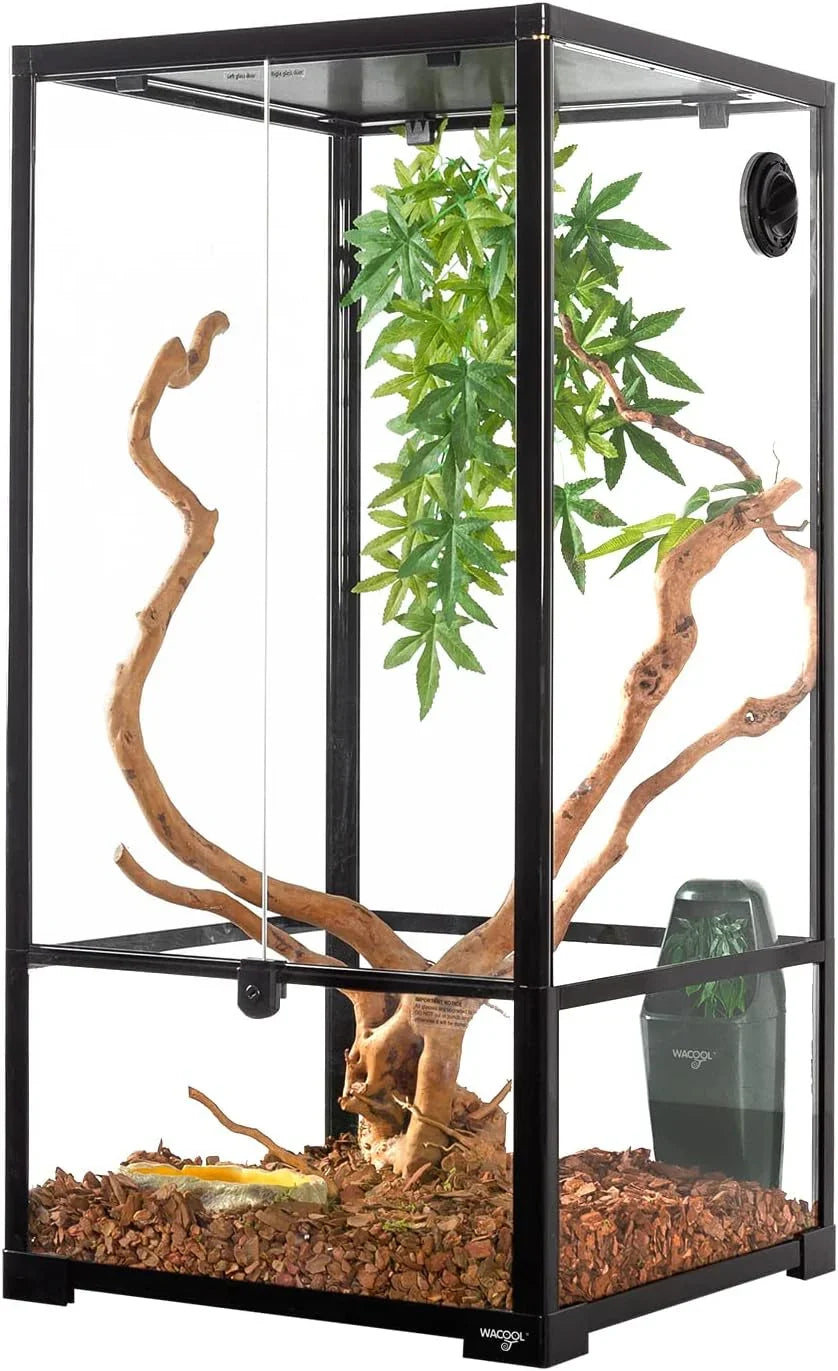
18x18x36 — Compact Adult Vertical Setup
The REPTIZOO RK454590 18" x 18" x 36" vertical terrarium provides the 18x18x36 dimensions used in the ReptiFiles juvenile/adult recommendation, without requiring a wider footprint. REPTIZOO's listing describes separately opening front doors, a screen top, a raised waterproof bottom, closable cable inlets, and side panels that can be assembled as all glass or as mesh plus glass. These configurations may affect ventilation and humidity retention differently. Choose based on your room's humidity and how much airflow your setup needs.
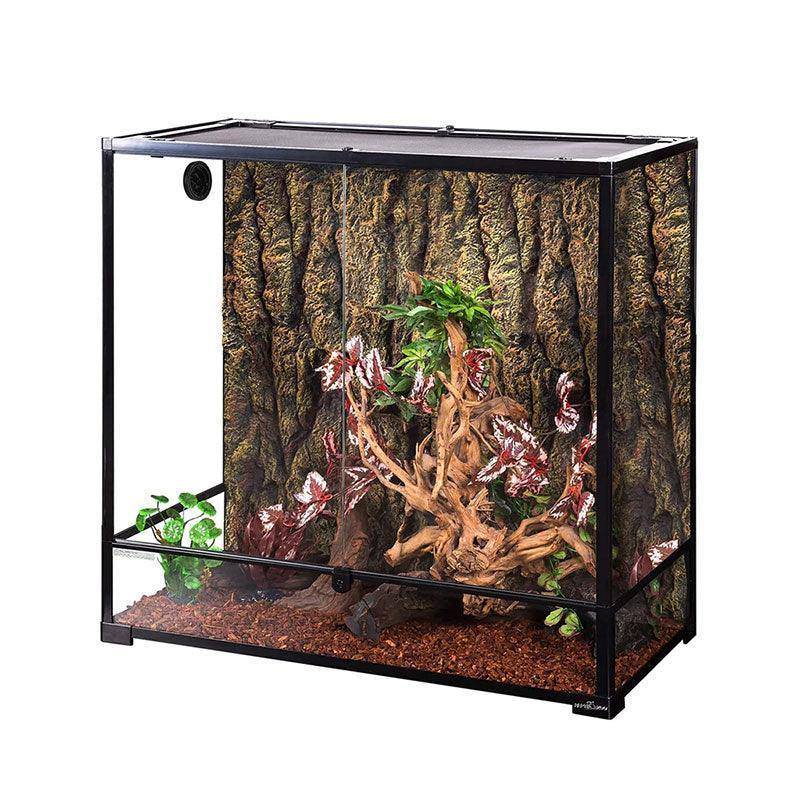
36x18x36 — Roomier Adult Habitat
The REPTIZOO RK0125 36" x 18" x 36" front-opening terrarium keeps the full 36-inch height and doubles the width. Its listing describes tempered glass, two separately opening front doors with a lock, a screen top, a raised waterproof bottom, and closable cable inlets. The extra room can support a more varied climbing layout, provided the enclosure has sufficient cover, secure perches, accessible food and appropriate environmental monitoring.
If you want more width than an 18x18x36 but have no room for a 36-inch-wide enclosure, the REPTIZOO RK0124N 24" x 18" x 36" vertical terrarium is an intermediate option.
| Enclosure Dimensions | Orientation | Best Use | Important Limitation | Product Link |
|---|---|---|---|---|
| 18 x 18 x 24 in | Vertical | Juvenile or transitional housing | Less height than the 18x18x36 adult baseline | RK0110 |
| 18 x 18 x 36 in | Tall vertical | Compact adult setup | Narrow footprint limits horizontal routes | RK454590 |
| 36 x 18 x 36 in | Tall and wide | Roomier, enriched adult habitat | Needs more floor space, furnishing, and maintenance | RK0125 |
How to Make the Most of a Tall Crested Gecko Tank
Branches, Vines, Hides, and Foliage
- Run branches and vines diagonally and horizontally to create routes up, down, and across.
- Add secure perches at several heights, including near the top.
- Use tall, broad plants to create areas of light and shade, as the RSPCA recommends.
- Provide hides, such as cork bark tubes, at more than one level.
- Leave gaps between perches so your gecko can jump between them.
Feeding Access, Temperature, Lighting, and Humidity
Mount feeding ledges where your gecko already spends time, and add more than one in larger enclosures. Check temperature and humidity at both the top and bottom of the enclosure with digital gauges, because conditions change with height.
- Temperature: Both sources describe a temperature gradient rather than one uniform temperature. ReptiFiles gives a daytime basking area of about 82–85°F (28–29°C), while the RSPCA lists a hot end of 26–28°C (79–82°F). Prevent overheating, use an appropriate thermostat with supplemental heat sources, and check the actual temperatures in the enclosure.
- Lighting and UVB: The RSPCA and ReptiFiles both discuss daytime lighting and UVB, but their output and placement guidance differ. Plan UVB using the specific lamp and fixture, the distance to accessible perches, the enclosure height, and any reduction caused by a mesh screen. Provide shade and a normal dark period at night; avoid colored night lights.
- Humidity: Both sources discuss periodic increases in humidity with an opportunity for the enclosure to dry down, rather than constantly saturated conditions. Their numerical ranges differ. Use hygrometer readings and the room’s climate, ventilation and planting to guide adjustments instead of relying on one fixed misting schedule.
For detailed setup guidance, see the ReptiFiles lighting, heating, and humidity guide.
Common Crested Gecko Tank Size Mistakes
- Choosing by gallons instead of comparing real dimensions.
- Buying a long but short tank, such as a 20-gallon long.
- Treating a minimum size as ideal for every adult.
- Leaving a tall tank nearly empty, with few branches or plants.
- Ignoring horizontal routes that give the gecko somewhere to jump.
- Forgetting about feeding access after an upgrade.
- Skipping ventilation and monitoring.
- Assuming a bigger tank makes cohabitation safe. Both the RSPCA and ReptiFiles describe the risks, and housing geckos individually is the safer default.
Before Buying a Crested Gecko Tank: Checklist
- Your gecko's current life stage and body size
- A plan for its adult enclosure
- Enough usable height for climbing
- Enough width and depth for horizontal routes
- Room for branches, vines, and plant cover
- Easy access to food and water
- Secure doors and lid
- Ventilation that suits your room's humidity
- Space for a thermometer and hygrometer
- Easy maintenance and a plan for future upgrades
Frequently Asked Questions About Crested Gecko Tank Size
What size tank does an adult crested gecko need?
An 18" x 18" x 36" vertical enclosure is a welfare-conscious baseline, and larger, well-furnished tall enclosures may offer additional room for climbing and enrichment. The RSPCA's 2015 care sheet lists a lower minimum of 45 x 45 x 60 cm.
Is an 18x18x24 tank enough for an adult crested gecko?
It roughly meets the RSPCA's published minimum. ReptiFiles uses 18x18x36 as its baseline instead. For long-term adult housing, a 36-inch-tall option offers additional vertical room.
Is an 18x18x36 enclosure better than an 18x18x24?
For adults, generally yes. Both have the same footprint, and the extra height adds climbing room and a clearer gradient from top to bottom.
Can a baby crested gecko live in a large tank?
Yes, as long as the tank has dense cover and food is placed close by, and you watch the gecko closely after the move.
Is a 20-gallon long tank suitable for a crested gecko?
Not as a long-term enclosure. It has floor space but very little height for a climbing species.
When should I upgrade my crested gecko enclosure?
Upgrade when your gecko outgrows its life-stage guidance or no longer has room to climb, hide, and move between temperature zones.
Can multiple crested geckos share a larger enclosure?
More space does not remove the risks of cohabitation. Keeping crested geckos separately is the safer default; housing multiple individuals together introduces territorial, feeding and breeding risks.
Is height or floor space more important?
Vertical climbing space is important for an arboreal gecko, but width and depth also matter for jumping, exploring, and creating light and temperature gradients.
Choose a Tank Based on Your Gecko's Needs
Start with your gecko's life stage. Compare real dimensions instead of gallon labels, and prioritize usable height along with horizontal routes. Choose a setup that makes climbing, hiding, feeding, monitoring, and maintenance practical, and consider more room when it can be furnished and maintained appropriately. For broader principles, see REPTIZOO's guide to choosing the right terrarium size.
Once you know which dimensions fit your gecko and your space, compare REPTIZOO's crested gecko terrarium options by real size, vertical climbing space, and features before you decide.
Sources & Further Reading
REPTIZOO Habitat Tip
A great reptile habitat starts with the right environment. Choose an enclosure that provides appropriate space, ventilation, lighting, temperature, and humidity for your reptile’s specific needs.
About REPTIZOO
REPTIZOO helps reptile keepers build complete habitats with thoughtfully designed terrariums, enclosures, lighting, heating, humidity control, and habitat accessories. Whether you're setting up a home for a bearded dragon, gecko, snake, chameleon, turtle, or other reptile, our goal is to make habitat building simpler, safer, and closer to nature.
Explore REPTIZOO habitat solutions and Live in Nature.