


Vivarium vs Terrarium: What's the Difference and Which Should You Choose?

Shop for a reptile enclosure and the same kind of glass box might be listed as a vivarium, a terrarium, or simply a reptile tank. So should you look for a vivarium or terrarium? Broadly speaking, a vivarium is an enclosure for living organisms maintained in conditions resembling their natural environment. A terrarium is a land-focused version of that idea, and the word also describes glass containers for growing plants. The meanings overlap, so a reptile terrarium can also be called a vivarium. What matters is whether the enclosure's design fits the animal you plan to keep.
Vivarium vs Terrarium: The Quick Answer
The short version of the vivarium vs terrarium question: the two words describe different emphases, not two separate categories of product.
What Is a Vivarium?
Dictionary.com defines a vivarium as a place where live animals or plants are kept under conditions simulating their natural environment (Dictionary.com). That covers a research facility, a planted display, or a home reptile enclosure.
In the reptile hobby, "vivarium" usually means an enclosure for reptiles or amphibians. By the broad definition, though, it doesn't have to contain an animal; an enclosure of living plants also qualifies.
What Is a Terrarium?
"Terrarium" has two common meanings (Dictionary.com):
- A vivarium for land animals, as distinguished from an aquarium.
- A mostly or fully enclosed glass container for growing and displaying plants.
When a reptile retailer calls an animal enclosure a terrarium, the land-based meaning is usually intended.
Are They the Same Thing?
Not exactly, but they overlap heavily. Because one dictionary meaning of terrarium is a vivarium for land animals, a reptile terrarium housing a leopard gecko is also a vivarium in the broad sense. The reverse isn't always true: a vivarium can be semi-aquatic or aquatic, which "terrarium" doesn't emphasize.

Vivarium is a broad term; terrarium emphasizes a land-based environment. The labels overlap.
Table 1: Vivarium vs Terrarium Comparison
| Vivarium | Terrarium | |
|---|---|---|
| Terminology / focus | Broad: any enclosure for living organisms in simulated natural conditions | Land-focused enclosure; also a glass plant container |
| Typical application | Reptile, amphibian, invertebrate, or research habitats; planted displays | Reptile and amphibian land habitats; decorative plant terrariums |
| Possible inhabitants | Animals, plants, or both | Land animals, plants, or both |
| Planting and bioactive use | Common but optional | Common but optional |
| Ventilation and equipment | Set by the inhabitants, not the label | Set by the inhabitants, not the label |
| Important caveats | Not automatically wooden, planted, or bioactive | Not automatically glass or plant-only; a reptile terrarium is also a vivarium |
Key Differences That Matter for Reptile Keepers
Living Organisms vs Land-Based Habitat Design
"Vivarium" emphasizes what lives inside; "terrarium" emphasizes a land habitat. Two retailers can sell nearly identical glass enclosures under different names, so the label reflects the seller's vocabulary, not the product's suitability.
Glass, Wood, and PVC: Materials Are Not Definitions
Some UK retailers use "vivarium" mainly for wooden enclosures with sliding glass doors and "terrarium" for glass enclosures, as in this Northampton Reptile Centre explainer. That's a market naming convention, not a technical classification, and the same source notes the terms are often used interchangeably.
Materials still matter. Glass offers visibility and easy cleaning; wood and PVC are often chosen for insulation and solid sides, though wood needs sealing where it meets moisture. Heat and humidity retention also depend on ventilation, lid design, and room conditions.
Ventilation, Humidity, and Temperature Control
Whatever the enclosure is called, its design should support a species-appropriate climate. The Merck Veterinary Manual emphasizes choosing the enclosure type for the animal and managing its thermal environment:
- Ventilation suited to the species. Mesh and vent placement affect airflow, and greater ventilation can make humidity harder to maintain in some rooms.
- A heat gradient with warmer and cooler zones; enclosure length shapes how easily you can build one.
- Thermostat-controlled heating, positioned so the animal can't touch hot surfaces.
- Humidity, which varies by species and should be measured with a hygrometer.
- Equipment placement for lamps, UVB fixtures, and cables, planned before you buy.
No single temperature or humidity range applies to "a vivarium" or "a terrarium." Follow current guidance for your species.
Live Plants, Bioactive Substrate, and Maintenance
Either label can describe a planted enclosure. A vivarium doesn't need plants, and a terrarium can be bioactive.
A bioactive habitat typically combines live plants, layered substrate, and a cleanup crew such as isopods and springtails that help break down waste. It isn't maintenance-free: you'll still spot-clean, prune, manage moisture, and refresh substrate over time.
Which Should You Choose for Your Reptile?
Instead of choosing between a "vivarium" and a "terrarium," choose an enclosure shape and feature set that match how your animal lives.
Tropical and Climbing Species
Arboreal species generally need:
- Vertical space for climbing and perching.
- Branches, plants, and cover.
- A balance of humidity and airflow.
- Room for overhead equipment and front access for misting and cleaning.
Crested geckos are a familiar example. ReptiFiles recommends that height take priority for this species, while noting that floor space still matters for hopping and thermoregulation (ReptiFiles). Our crested gecko tank size guide covers sizing in detail.
Height alone doesn't make an enclosure right for every climber. Chameleons, for example, should be housed according to species-specific guidance on ventilation and enclosure type, not simply placed in the tallest glass tank available.
Terrestrial and Arid-Loving Species
Ground-dwelling species typically need:
- Floor space to roam and thermoregulate.
- A horizontal thermal gradient along the enclosure's length.
- Hides on the warm and cool sides and a species-appropriate substrate.
Leopard geckos, bearded dragons, and blue tongue skinks are all commonly kept, but their needs differ. ReptiFiles emphasizes strong UVB lighting and a suitable basking area for bearded dragons (ReptiFiles). Leopard geckos have different lighting needs, but can also benefit from appropriately provided UVB; they also need access to a humid hide (ReptiFiles). For skinks, see our blue tongue skink enclosure guide.
Planted and Bioactive Habitats
For planted or bioactive layouts, check that the enclosure leaves room for drainage, enough substrate depth for roots and cleanup crews, wetter and drier zones, foliage above the substrate line, and access for pruning and spot-cleaning.
For a detailed humidity-dependent example, see our planted dart frog enclosure setup.
Five Things to Check Before Choosing a Vivarium or Terrarium
1. Species and Expected Adult Size
Start with the exact species and its expected adult size. A young animal may fit a smaller enclosure for a while, but plan for adult housing. Where current husbandry sources disagree, lean toward the more generous recommendation.
2. Horizontal Floor Space vs Vertical Climbing Room
Gallon capacity doesn't tell you where the space is. A tall, narrow tank may suit a climber but leave a terrestrial animal short on floor area, and extra height doesn't make up for too little floor. Listed dimensions are usually external, and substrate, backgrounds, and décor reduce usable space further.
3. Ventilation and Climate Requirements
Enclosure design, heating, humidity control, and room climate all interact; a screen top behaves differently in a dry, air-conditioned room than in a humid basement. Plan your gradient and humidity for your space, then check that the ventilation supports it.
4. Substrate, Drainage, and Water Features
Be clear about which of these you need, because each asks more of the enclosure:
- Damp substrate that helps hold humidity.
- A drainage layer beneath the substrate to collect excess water.
- A water dish for drinking or soaking.
- A water feature or aquatic zone with open standing water.
A raised waterproof lower section may help contain damp substrate and incidental moisture, but its stated height is not necessarily an approved standing-water depth. Do not treat a reptile terrarium as an aquarium unless the manufacturer explicitly supports that use. Confirm the intended use before planning a water feature.
5. Front Access, Security, and Equipment Compatibility
- Front-opening doors make feeding, spot-cleaning, and maintenance more convenient and reduce reaching down through the top.
- Secure door locks and properly closed openings help reduce escape risks. Additional supervision may still be necessary around children or other pets.
- Screen tops should suit your lighting and heating plan.
- Cable inlets keep wiring tidy and limit gaps.
Pre-Purchase Reptile Enclosure Checklist
- ☐ I've identified the exact species I'll keep.
- ☐ I've researched current adult enclosure recommendations for that species.
- ☐ I've checked usable interior floor space, not just the gallon rating.
- ☐ I've assessed whether my animal needs climbing height and whether the enclosure provides it.
- ☐ I have a heating and ventilation plan, including thermostat control.
- ☐ I've verified my species' humidity needs and how I'll measure them.
- ☐ I've allowed for substrate depth in my height calculations.
- ☐ I've confirmed the enclosure's intended water use if I need a water feature.
- ☐ I've checked door access, locks, and escape security.
- ☐ I've planned equipment placement and ongoing maintenance.
With these answers in hand, you'll know what size and layout to look for when you browse REPTIZOO reptile terrariums.
REPTIZOO Terrarium Sizes for Different Habitat Layouts
REPTIZOO offers enclosures in several dimensions and configurations, but the right model depends on your animal's species, adult size, behavior, and environmental needs.
Compact Vertical Setups: 18" × 18" × 24"

A compact vertical enclosure can suit a small planted or climbing layout for appropriately small species and life stages. The REPTIZOO RK0110 18" × 18" × 24" terrarium is tempered glass with two hinged front doors, a removable screen top, and a raised waterproof bottom.
This is not a default adult crested gecko enclosure. ReptiFiles lists 18" × 18" × 36" as a baseline minimum for juveniles and adults over 12 g (ReptiFiles), so check species guidance before choosing a compact enclosure for long-term housing.
Taller Planted Setups: 36" × 18" × 36"

Compared with the compact 18" × 18" × 24" option, a 36" × 18" × 36" enclosure offers twice the length and 12 additional inches of height, with the same 18" depth. That leaves more room for planted backgrounds, branches, and layered climbing routes. The REPTIZOO RK0125 36" × 18" × 36" terrarium has two front-opening doors, a screen top, a raised waterproof bottom, and closable cable and tubing inlets.
Extra height helps only if the animal can use it and airflow and heat distribution still suit the species.
Large Horizontal Setups: 48" × 24" × 24"
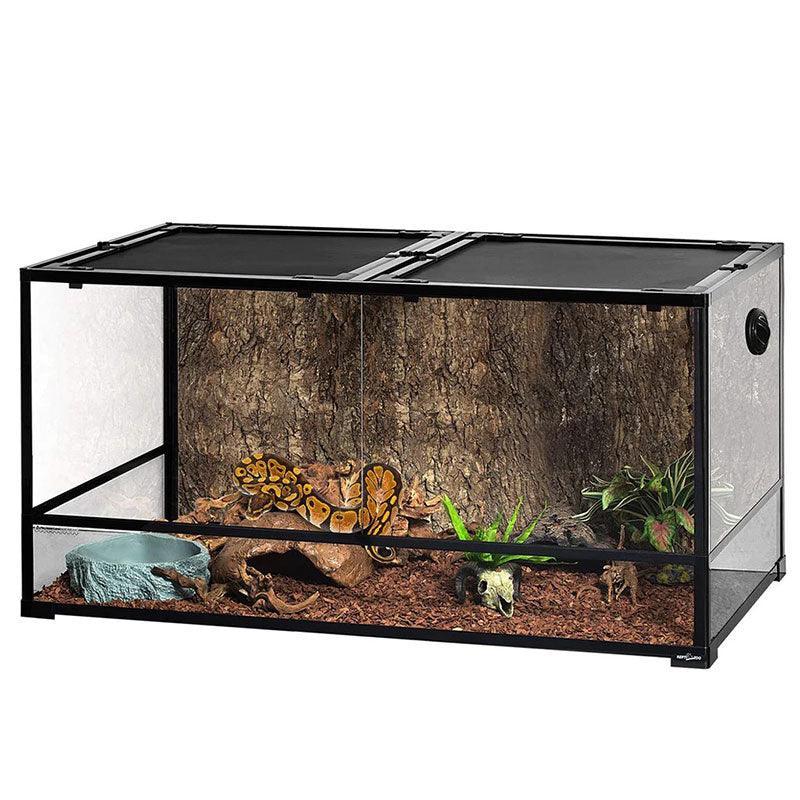
A 48" × 24" footprint gives terrestrial species more room for a long heat gradient, multiple hides, and varied terrain. The REPTIZOO RK0240 48" × 24" × 24" terrarium uses sliding front doors and a screen top, with a waterproof-height option labeled 5.5". That figure describes the waterproof lower section, not an approved water depth.
This footprint isn't sufficient for every large adult reptile, so compare it with the guidance for your animal.
When a Larger or More Specialized Enclosure Is Needed
Some animals need more length, more usable height, extra substrate depth, a different ventilation layout, or dedicated water handling. The REPTIZOO 48" × 24" × 36" 180-gallon terrarium keeps the 48" × 24" footprint and adds 12" of height, with double sliding doors and top mesh ventilation, for more enriched or planted layouts. The additional space is most useful when it is appropriately furnished and climate-controlled for the animal.
Table 2: REPTIZOO Enclosure Size Comparison
| Enclosure dimensions | Orientation | Possible habitat layout | Main practical benefit | Important limitation |
|---|---|---|---|---|
| 18" × 18" × 24" | Vertical | Compact planted or climbing layout | Small footprint with front access | Below some species' recommended minimums; limited floor and height |
| 36" × 18" × 36" | Tall | Layered planted or arboreal layout | Twice the length and 12" more height than 18×18×24 | Height helps only if furnished; 18" depth |
| 48" × 24" × 24" | Horizontal | Terrestrial layout with a long thermal gradient | Larger floor area for hides and gradients | Not sufficient for every large adult reptile |
| 48" × 24" × 36" | Large, tall | Enriched or planted display layout | Same footprint as 48×24×24 plus 12" of height | More space to heat, light, and maintain |
These are published external dimensions and are not species minimums. To compare specifications side by side, see our reptile enclosure options.
Vivarium, Terrarium, and Paludarium: Where Does Water Fit?
A paludarium is a type of vivarium that combines a substantial land area with a substantial water area. That's different from a mainly terrestrial enclosure with a water dish or damp substrate.
Paludariums need reliable water containment and land-water separation, and our paludarium setup guide covers the build.
Common Mistakes When Choosing a Reptile Enclosure
- Choosing by label alone. "Vivarium" or "terrarium" says nothing about fit; check dimensions, ventilation, and access.
- Buying by gallons. Compare length, depth, and height instead.
- Too little usable space. Account for substrate and décor, and check floor area and climbing room separately.
- Ignoring climate control. Match ventilation and heating to both your species and your room.
- Assuming a glass tank can hold standing water. A waterproof lower section does not by itself make a terrarium suitable for aquarium use.
- Expecting bioactive to be maintenance-free. Plants, substrate, and moisture still need regular attention.
FAQs About Vivariums and Terrariums
What is the main difference between a vivarium and a terrarium?
Vivarium is a broad term for an enclosure maintaining living organisms in conditions resembling their natural environment. A terrarium is a land-focused vivarium, or a glass container for plants. In reptile keeping the terms overlap, and a reptile terrarium can also be called a vivarium.
Is a vivarium always made of wood?
No. Some UK retailers use "vivarium" mainly for wooden enclosures with glass doors, but that's a naming convention. By definition, a vivarium can be glass, PVC, wood, or another material. Choose based on the climate and ventilation your species needs.
Does a vivarium need live plants?
No. Live plants can support humidity and enrichment, but they add care and must be safe for the animal. Artificial décor is a common alternative.
Can a terrarium be bioactive?
Yes. A bioactive terrarium uses live plants, layered substrate, and a cleanup crew to help process waste. It still needs spot-cleaning, pruning, and moisture management.
Is a glass terrarium suitable for tropical reptiles?
It can be, if ventilation and climate match the species. Glass is widely used for humid setups, but airflow, lid design, and room conditions all affect results. Some arboreal species have specific ventilation needs, so check species guidance first.
Is a paludarium the same as a vivarium?
A paludarium is one type of vivarium, defined by large land and water areas in one enclosure. A terrestrial terrarium with a water dish or damp substrate isn't a paludarium.
Can any reptile terrarium hold water?
No. Not necessarily. A waterproof lower section can help contain damp substrate or incidental moisture, but its published height does not establish a safe water depth. Check the manufacturer's intended use before adding a standing-water feature.
Final Thoughts: Choose the Habitat, Not Just the Label
Whether a product is called a vivarium or a terrarium matters far less than whether it fits your animal. Dimensions, usable space, ventilation, heating, humidity, substrate, and maintenance access determine whether a habitat works. Start with your species, plan the climate and layout, then choose an enclosure that supports it. When you're ready, explore REPTIZOO reptile terrariums to find a size and configuration that fits your setup.
References & Further Reading
- Dictionary.com — Vivarium vs. Terrarium — broad terminology definitions.
- Merck Veterinary Manual — Management and Husbandry of Reptiles — enclosure planning, temperature gradients and heating safeguards.
- ReptiFiles — Crested Gecko Enclosure Size & Cohabitation — size and climbing-space context.
- ReptiFiles — Bearded Dragon Lighting, Heating & Humidity — species-specific lighting and basking considerations.
- ReptiFiles — Leopard Gecko Lighting, Heating & Humidity — species-specific lighting and humidity considerations.
- Northampton Reptile Centre — Vivarium vs Terrarium — an example of UK retail naming conventions, not a universal definition.
REPTIZOO Habitat Tip
A great reptile habitat starts with the right environment. Choose an enclosure that provides appropriate space, ventilation, lighting, temperature, and humidity for your reptile’s specific needs.
About REPTIZOO
REPTIZOO helps reptile keepers build complete habitats with thoughtfully designed terrariums, enclosures, lighting, heating, humidity control, and habitat accessories. Whether you're setting up a home for a bearded dragon, gecko, snake, chameleon, turtle, or other reptile, our goal is to make habitat building simpler, safer, and closer to nature.
Explore REPTIZOO habitat solutions and Live in Nature.