


UVB Lighting Requirements for Reptiles: Species Needs & Terrarium Setup

Quick answer: UVB lighting requirements for reptiles vary by species. Choosing a lamp is only the first step. The UVB that actually reaches your reptile depends on the lamp, fixture, reflector, screen mesh, and distance. A suitable habitat provides species-appropriate exposure where the animal basks or perches, plus easy access to shade.
This guide explains what UVB does, how needs differ between species, how to read lamp labels, Ferguson Zones, and UV Index (UVI) figures, and how to install, measure, and adjust UVB in a real terrarium.
What Are UVB Lighting Requirements for Reptiles?
UVB lighting requirements describe the type, intensity, and placement of ultraviolet B light a reptile needs, and how that light is delivered inside its enclosure. The real requirement is an exposure level at the animal's position, not simply "a UVB bulb."
Why UVB Matters for Vitamin D3 and Calcium Metabolism
UVB in roughly the 290–315 nm range allows many reptiles to synthesize vitamin D3 in their skin, in a temperature-dependent reaction. Vitamin D3 in turn supports the absorption and use of dietary calcium. The Merck Veterinary Manual notes that many captive basking species appear susceptible to metabolic bone disease and that UV exposure is an important, often overlooked factor.
UVB is one part of a larger picture that also includes diet, supplementation, temperature, and overall husbandry. Merck also notes that how much UVB exposure is needed is not known for every species. No lamp guarantees healthy bones on its own.
UVB vs. UVA vs. Basking Heat vs. Visible Light
| Component | Main Role | What It Does Not Replace |
|---|---|---|
| UVB | Supports vitamin D3 synthesis in the skin of many species | Heat, visible light, or a balanced diet |
| UVA | Part of the light spectrum reptiles can see | UVB |
| Basking heat | Lets the reptile warm up and regulate body temperature | UVB (standard heat lamps may provide little or no useful UVB) |
| Visible light | Daytime brightness and day/night cues | UVB or heat |
A standard incandescent or halogen heat lamp does not necessarily provide biologically useful UVB. A fluorescent UVB tube is not a basking heat source. Some specialized lamps, such as mercury vapor bulbs, provide both heat and UVB. Merck notes they can become very hot and produce an intense UVB gradient over a small area, so their exposure still needs verifying.
How Much UVB Does Your Reptile Need?
Species, Activity Patterns, and Ferguson Zones
Ferguson Zones group reptiles by the amount of sunlight they typically expose themselves to in the wild. The groups run from shade-dwelling and crepuscular species (lower exposure) to open-sun baskers (higher exposure), and each zone is paired with a suggested UVI range for the animal's highest-exposure spot.
Treat the zones as a planning framework, not a prescription. A target must be interpreted for the specific species, its behavior, the type of exposure (a broad gradient or a focused basking spot), and the lighting system in use. The Reptile Lighting Guide V10 describes itself as offering "guidelines, not instructions," and notes that every vivarium and species is different.
UVB Planning Differences Across Common Pet Reptiles
The table below gives numbers only where a source was checked. Confirm targets for your species with a current care source or a reptile veterinarian.
| Species | General UVB Exposure Considerations | Habitat/Lighting Implications | What Must Be Verified |
|---|---|---|---|
| Bearded dragon | A strong day-active basker. In the Lighting Guide V10, the bearded dragon/ackie example narrative uses about UVI 4.0–5.0, while the guide's grouped poster lists about 4.0–4.5 for its "High Sunlight" basking-zone category. | UVB overlapping the basking zone, with a shaded cool end. See bearded dragon basking light setup. | Measured UVI at the basking surface |
| Leopard gecko | Crepuscular; spends much of the day in shelter | Any UVB provided should come with plenty of hides and shade | Species-specific guidance and actual exposure |
| Crested gecko | Crepuscular; often rests under foliage. ReptiFiles lists about UVI 1.0–2.0 at the basking branch, measured with a Solarmeter 6.5. | UVB at the top of a vertical enclosure with dense foliage below. See crested gecko enclosure size guide. | UVI at the upper basking branch |
| Blue tongue skink | Day-active terrestrial basker | Basking UVB across a horizontal footprint with shaded retreats. See blue tongue skink enclosure setup. | Species and locality guidance; measured UVI |
| Chameleon | Arboreal; needs vary between species | UVB over the upper branches, coordinated with perch arrangement and ventilation | Species-specific targets, perch heights, ventilation |
| Ball python | Mostly nocturnal or crepuscular; some specialist care guides recommend a controlled UVB gradient | If UVB is used, provide access to the lit zone alongside secure hides and shade; see ball python UVB guidance | Species-specific recommendations, measured exposure, and shaded retreats |
| Aquatic / semi-aquatic turtles | Bask on land or emergent surfaces | UVB over the dry basking platform | Species needs; distance to the platform |
About ball pythons: Their mostly nocturnal or crepuscular activity does not establish that access to UVB has no value. Husbandry recommendations vary; for example, ReptiFiles provides a ball python UVB setup method involving a specific lamp, basking-position measurements, and suitable shelter. Avoid assigning every ball python a fixed UVB level from its activity pattern alone. When providing UVB, verify the setup for the individual enclosure and maintain shaded hides.
About chameleons: No single UVB prescription applies to all chameleons. Species, perch arrangement, and ventilation needs all change the right setup.
Why UVB 5.0 and 10.0 Are Not Measured UVI
Four different things often get confused:
- Nominal labels, such as "5.0" or "10.0", describe the lamp's relative UVB output.
- Manufacturer percentages, such as "6%" or "12%", are another way of rating a lamp's output.
- Ferguson Zones describe a species' typical exposure behavior.
- Measured UV Index is the UVB actually reaching a specific point, ideally the animal's position.
A bulb label is never a UVI reading. A "10.0" lamp mounted high above mesh may deliver less UVI than a "5.0" lamp mounted closer without mesh. The actual exposure depends on lamp output, fixture and reflector, mounting distance, any mesh in between, and lamp age.
Which Type of Reptile UVB Light Should You Choose?
Linear T5 HO vs. T8 UVB Lamps
Linear tubes spread UVB along their length. T5 HO (high output) lamps generally deliver more UVB at a given distance than T8 lamps. That can suit taller enclosures, lamps mounted above mesh, or strong baskers. T8 lamps generally produce less output, which can suit some lower-exposure setups. Neither type is universally better. The right choice depends on lamp output, reflector, mounting distance, and enclosure geometry.
Compact Bulbs, Mercury Vapor Lamps, and UVB LEDs
| Technology | Key Characteristics | Main Limitations | Verify Before Installation |
|---|---|---|---|
| T5 HO linear | Higher output; broad coverage; often paired with a reflector | Can be too intense if mounted too close | Manufacturer output data; mounting distance; mesh |
| T8 linear | Lower output; broad coverage | May fall short at greater distances or through mesh | Output at the planned distance |
| Compact fluorescent | Concentrated UVB over a small area (Merck) | Small coverage area | Coverage of the basking spot |
| Mercury vapor | Heat, light, and an intense UVB gradient over a small area | Runs very hot; the animal needs a way to escape the beam | Heat and UVI at the basking spot; safe clearance |
| UVB LED | Newer technology | Merck notes more research is needed and that overexposure is possible | Manufacturer data plus measured UVI at the animal's position |
Advertised modes on an LED or switchable fixture do not by themselves confirm the UVI reaching your reptile. Newer technology is not automatically safer or more effective.
Reflectors, Fixtures, and Manufacturer Output Data
A reflector directs more UVB downward and increases exposure at a given distance. Fixture design and mounting also matter, so use model-specific manufacturer output charts rather than general distance rules. For example, Arcadia publishes UVI data for its ProT5 lamps, measured with a Solarmeter 6.5, and specifies a 250 mm (about 10-inch) minimum lamp-to-reptile distance for that product. That figure applies to Arcadia's product only and should not be applied to other brands. REPTIZOO's UVB fixtures and reflectors cover a range of mounting options.
Compare REPTIZOO reptile UVB lighting options to find a fixture that fits your species, enclosure layout, and mounting requirements.
How to Set Up UVB Lighting in a Reptile Enclosure
Step 1: Plan the Basking and Shaded Zones
Sketch the enclosure first. Mark where the reptile will bask or perch, where it will retreat, and where its hides go. The goal is a gradient: the highest UVB where the animal basks, tapering to shade elsewhere.
UVB coverage does not need to span the full enclosure width or length. A lamp's length should match the gradient you planned, not the enclosure's length. A tube that runs the full length can leave no low-UV retreat, especially in a short enclosure.
Step 2: Position UVB Relative to Basking Heat
For many basking species, positioning UVB to overlap the daytime heat source encourages the animal to receive both together. Merck notes that placing a heat bulb next to a UVB bulb helps ensure lizards that seek warm spots also get UVB exposure. Heat and UVB still do different jobs, so verify each one separately. Species that do not bask in the open may need a different arrangement.
Step 3: Account for Screen Mesh, Glass, and Obstructions
- Glass and plastic: Standard glass and most plastics block nearly all of the relevant UVB. Never mount UVB behind a glass lid or a plastic cover.
- Mesh tops: Mounting above mesh is common and protects the animal from contact with the lamp, but mesh reduces transmitted UVB. The reduction varies by mesh, so there is no universal percentage.
- Mounting inside: Mounting inside the enclosure removes the mesh loss, but the lamp must be guarded and placed out of reach, and the fixture must be suitable for internal use.
- Decor and plants: Branches and foliage create shade, which is useful, but they can also block UVB at the basking spot.
Step 4: Measure Distance at the Reptile's Actual Position
Measure from the lamp to the surface the animal occupies, and account for the animal's body height. A basking lizard's back sits above the platform surface. Substrate depth, raised platforms, and branch elevation all shorten the distance.
In horizontal enclosures, the distance is set mainly by platform height. In vertical enclosures, perches at different heights receive different exposure, so the top perch may need checking for overexposure. Keep fixtures securely mounted, leave clearance around hot equipment, and make sure the animal cannot touch any lamp.
Step 5: Set a Species-Appropriate Day/Night Schedule
A consistent photoperiod, meaning the daily light-dark cycle, supports normal daily rhythms. Needs vary by species, and some keepers adjust seasonally. Merck notes that seasonal photoperiod changes are generally most relevant for breeding animals. Use a timer to keep the schedule consistent.
How to Measure and Adjust UVB Exposure
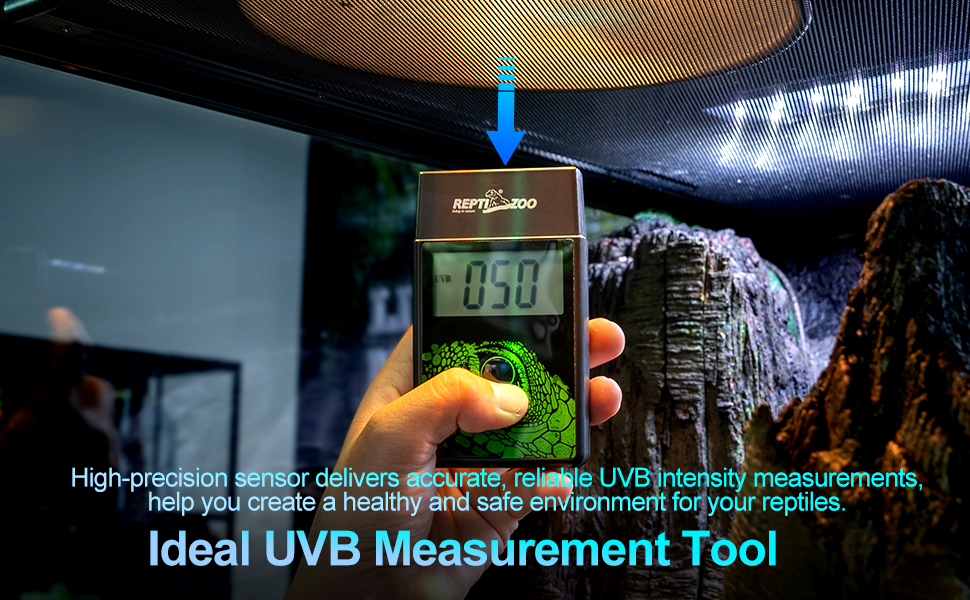
What a UV Index Meter Tells You
A UV Index meter suited to reptile lamps, such as a Solarmeter 6.5 or 6.5R, measures the UVI at a specific point. Thermometers, hygrometers, smartphone light meters, and how bright a lamp looks cannot establish UVI. A bright lamp is not necessarily a strong UVB source.
Check the Basking Area and the Shade Gradient
Use this workflow:
- Set a reference. Identify a species-appropriate UVI range from a credible source, and note what that source measured (for example, at a basking branch).
- Check the installation. Confirm the lamp model, fixture, reflector, mesh, and mounting are as planned, and that the lamp has been running long enough for the manufacturer's recommended warm-up.
- Position the meter. Place the sensor where the animal's back sits when basking or perching, not on the enclosure floor.
- Orient the sensor. Point the sensor toward the lamp, as the meter's instructions describe. Readings change with angle and position.
- Compare zones. Measure the basking or perch area, then several points toward the shaded areas, to confirm a gradient exists.
- Adjust as needed. If exposure is too high or too low, adjust platform or branch height, lamp distance, the reflector, mesh, or the lamp model.
- Recheck. Measure again after every change.
- Record. Log the details so you can track lamp output over time.
Example measurement record (template only — no actual values):
| Date | Lamp model and age | Fixture / reflector | Mesh? | Distance to animal's back | Basking UVI | Shade UVI | Notes |
|---|---|---|---|---|---|---|---|
| ___ | ___ | ___ | ___ | ___ | ___ | ___ | ___ |
If you don't have a UV Index meter: Use model-specific manufacturer output data, account for the reflector, mesh, and mounting distance, and ask an experienced specialist if you're unsure. Without a measurement, you cannot confirm the actual UVI.
When to Recheck Your UVB Setup
Recheck after any of these changes:
- Moving a lamp
- Changing a reflector
- Replacing a bulb
- Changing the mesh or enclosure top
- Raising a basking platform
- Changing substrate depth
- Moving climbing branches
- Switching to a taller enclosure
UVB Setup Examples for Different Terrarium Sizes
These examples show how to plan UVB in different enclosures. They are not fixed lamp-length or wattage prescriptions.
48" × 24" × 24": Horizontal Bearded Dragon Setup
A 48" × 24" × 24" footprint, such as the REPTIZOO 48x24x24 terrarium, allows a basking zone at one end with UVB overlapping it, a thermal gradient along the length, and a shaded retreat at the cool end. Size the UVB coverage to that gradient rather than to the full 48 inches. Measure the UVI at the dragon's back on the basking platform. For heat-lamp selection and basking temperatures, see the bearded dragon basking light setup guide. Published minimum enclosure sizes for adult bearded dragons vary, so match the enclosure to the individual animal.
36" × 18" × 18": Lower-Profile Leopard Gecko Setup
In a lower enclosure like the REPTIZOO 36x18x18 terrarium, the lamp sits closer to the animal, so exposure can rise quickly when it climbs onto decor. Measure rather than assume. Plan for accessible hides along the gradient and a clear low-UV retreat. This size is not a first-choice permanent home for larger reptiles.
36" × 18" × 36": Vertical Climbing Reptile Setup
<!-- IMAGE SLOT 4: REPTIZOO 36 x 18 x 36 vertical enclosure with climbing branches and shaded perches. -->
In a tall enclosure such as the REPTIZOO 36x18x36 terrarium, the highest perch receives the most UVB, and lower branches receive progressively less. Measure at every perch the animal uses, and leave shaded perches available. This product is offered with full-glass sides or four-sided mesh. The two configurations differ in ventilation and humidity retention, which matters for species such as chameleons that need particular airflow. Choose based on species requirements.
Compact Vertical Setups: Extra Distance and Shade Checks
In compact enclosures such as 18" × 18" × 24", the top perch can sit close to the lamp. Check exposure there carefully and provide dense shade below. This size suits appropriate small species or juvenile and transitional setups. It is not a universal adult crested gecko enclosure.
If your current terrarium makes it difficult to create appropriate lighting and shaded zones, explore REPTIZOO front-opening reptile terrariums in different sizes.
Reptile UVB Lighting Setup Checklist
- Species UVB guidance verified with a credible source
- Lamp and fixture compatibility checked
- Manufacturer instructions and output data reviewed
- Basking and shaded zones planned; UVB coverage sized to the gradient
- Heat and UVB placement coordinated
- No glass or plastic between the lamp and the animal; mesh effect considered
- Distance measured to the animal's back at its basking or perching height
- UV Index measured, or the limits of manufacturer data acknowledged
- Day/night schedule set on a timer
- Fixture secure, guarded, and out of reach
- Measurement record and replacement schedule kept
Common UVB Lighting Mistakes and How to Fix Them
Mounting UVB Behind Glass or Plastic
Glass and most plastic barriers block UVB. Mount the lamp above mesh, or inside the enclosure with a guard, with no glass or plastic covering it.
Ignoring Mesh and Lamp Distance
Mesh and added distance both reduce exposure. Check the manufacturer's data and measure the UVI at the animal's position.
Providing UVB Without a Shaded Retreat
A lamp that covers the whole enclosure leaves the reptile no way to reduce its exposure. Keep shaded zones available.
Using Bulb Labels Instead of Measured Exposure
Labels and percentages describe the lamp, not your setup. Measure the UVI where the animal sits.
Forgetting Output Checks and Lamp Replacement
UVB output can decline with use even while a lamp still looks bright. Merck describes roughly annual replacement as general guidance, but individual manufacturers may specify shorter or longer intervals. Follow the instructions for your exact lamp and review UV Index measurements where available; do not assume one replacement schedule fits all technologies.
REPTIZOO Lighting and Terrarium Options for a UVB-Friendly Setup
When a Lighting Upgrade Is Enough
If your enclosure already provides enough space and shade, the fix may be a compatible fixture, a different tube, a reflector, or a better lamp position. Start with REPTIZOO's reptile UVB lighting options.
When Enclosure Size or Height Changes the Plan
A different enclosure can give you more room for separate lighting zones and enrichment, but changing the height also changes the lamp-to-animal distance. A bigger enclosure does not automatically solve a UVB problem. Explore the REPTIZOO terrarium range when space is the limiting factor.
REPTIZOO UVB Fixtures and Terrarium Examples
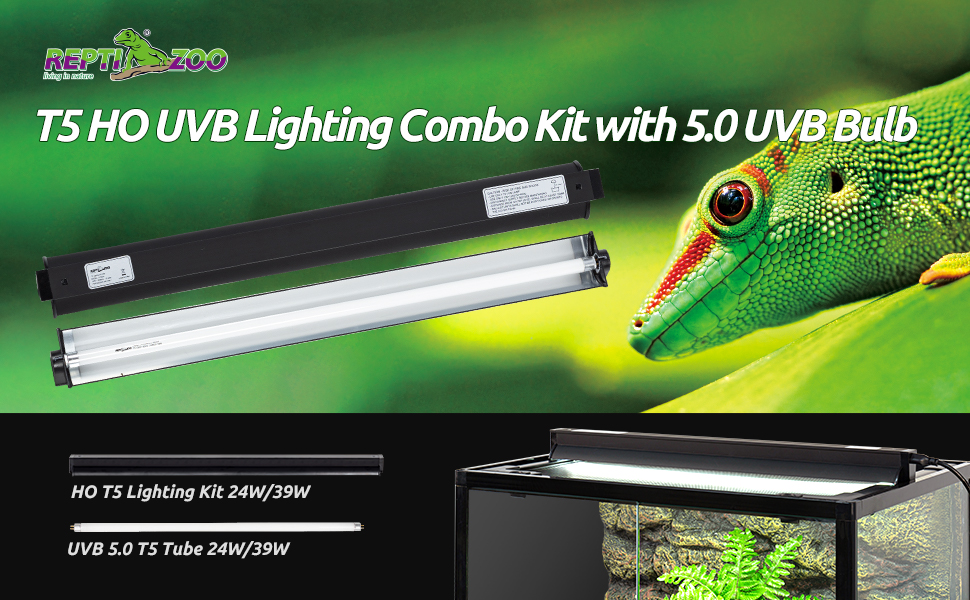
- T5 HO UVB Lighting Combo Kit: A T5 HO fixture with a polished reflector and a Desert 10.0 lamp, offered in several lengths. Choose a length based on the UVB coverage you planned, then measure.
- Switchable T5 UVB Light: A T5 fixture with a button for switching between desert and tropical modes. Measure the output in the mode you use.
- Dimmable UVB LED Light: An LED fixture with selectable modes and a timer. Its advertised modes do not confirm the UVI at your reptile's position, so verify with a meter.
For broader options, including bearded dragon setups, see REPTIZOO's bearded dragon lighting.

Frequently Asked Questions About Reptile UVB Lighting
Do all pet reptiles need a UVB light?
Not every reptile has the same UVB needs. Many day-active species, such as bearded dragons, are widely recommended to have UVB. For crepuscular or nocturnal species, recommendations vary and are generally lower. Follow a current care source for your species, and provide shade wherever you use UVB.
How many hours a day should reptile UVB lighting stay on?
It depends on the species and your husbandry approach. Many keepers use a consistent daily cycle, and some vary day length by season, especially for breeding animals. A plug-in timer keeps the schedule steady. Check a species-specific care source for appropriate durations.
What is the difference between UVB 5.0 and 10.0?
They are nominal output labels, with 10.0 generally indicating higher output. Neither is a UV Index reading. Actual exposure depends on distance, fixture, reflector, mesh, and lamp age, so measure at the animal's position.
Can UVB pass through glass or plastic?
Standard glass and most plastics block nearly all useful UVB. Never mount a UVB lamp behind a glass lid or plastic cover. Mount it above mesh or inside the enclosure with a guard.
Does a mesh screen reduce UVB exposure?
Yes. Mesh reduces the UVB reaching the animal, and the amount depends on the type of mesh. Account for it by using the manufacturer's data for mesh mounting where available, and by measuring the UVI at the basking position.
How far should a UVB lamp be from a reptile?
There is no universal distance. It depends on the lamp model, fixture, reflector, mesh, and the target UVI for your species. Follow the manufacturer's model-specific guidance. Do not apply another brand's stated installation distance to your own fixture. Measure the UVI at the animal's basking or perching height and confirm that it has a usable lower-UV retreat.
How do I know whether my UVB setup is working?
Measure it. A reptile-suitable UV Index meter placed at the animal's basking or perch position shows the actual UVI, and readings across the enclosure confirm that a shaded gradient exists. Lamp brightness, thermometers, and phone apps can't tell you this.
How often should reptile UVB bulbs be replaced?
Follow the manufacturer's instructions for your specific lamp. Merck describes roughly annual replacement as a general guideline, but some products recommend shorter intervals. Regular UV Index measurement is the most reliable way to tell when output has dropped.
Build a Better UVB Lighting Setup for Your Reptile
Verify your species' UVB needs, plan the basking and shade zones, choose compatible equipment, install it, measure at the animal's position, and recheck after every change.
Planning a new habitat or upgrading your lighting? Explore REPTIZOO's reptile UVB lighting options and front-opening terrariums, then verify the final setup against your reptile's specific needs.
References
REPTIZOO Habitat Tip
A great reptile habitat starts with the right environment. Choose an enclosure that provides appropriate space, ventilation, lighting, temperature, and humidity for your reptile’s specific needs.
About REPTIZOO
REPTIZOO helps reptile keepers build complete habitats with thoughtfully designed terrariums, enclosures, lighting, heating, humidity control, and habitat accessories. Whether you're setting up a home for a bearded dragon, gecko, snake, chameleon, turtle, or other reptile, our goal is to make habitat building simpler, safer, and closer to nature.
Explore REPTIZOO habitat solutions and Live in Nature.